

Key takeaways
- Compare the best crimping tools for electrical terminals, from plier-style crimper cutters to full-cycle ratcheting models and interchangeable die sets.
A crimped terminal is a mechanical joint, and the tool that forms it decides whether that joint carries current for years or works loose inside an enclosure. The wiring that passes over a workbench is mostly low-voltage lead work: power supply harnesses, fan leads, drive enclosure wiring, automotive accessories and test rigs. The five tools below are general electrical terminal crimpers for solderless insulated and non-insulated terminals, the red, blue and yellow connectors that fill most parts bins. They are a different class from modular plug crimpers and small pin crimpers, which use their own dies and techniques.
As an Amazon Associate, we earn from qualifying purchases.
Quick answer
For most terminal work, a full-cycle ratcheting crimper such as the Klein Tools 3005CR or the Titan 11477 gives the most repeatable crimps on insulated terminals from 22 to 10 AWG. Choose a plier-style tool such as the Klein Tools 1005 for mixed insulated and bare terminals in tight spaces, and a die-change set when heat shrink or flag terminals are part of the job.
Klein Tools 1005 Crimping and Cutting Tool

The Klein Tools 1005 is the classic plier-style crimper, a single forged tool that crimps both insulated and non-insulated solderless terminals and connectors from 10 to 22 AWG. The crimping die is marked for the two terminal types, so the correct nest is easy to identify before the squeeze. A specially hardened wire cutter sits in the nose, which means a lead can be trimmed to length and terminated with the same tool, and the tapered nose design reaches into confined spaces where a wider ratcheting head will not fit. The joint is hot-riveted for smooth action with no handle wobble, and the plastic-dipped handles are cushioned, with red grips. Klein lists the overall length at 9.6 inches and the weight at 12.8 ounces, and the tool is made in the USA. Two honest limits define it. Crimp pressure comes entirely from hand force, so results vary more than with a ratchet tool, and the maker warns that the plastic-dipped handles are not insulation and give no protection against electrical shock. For a mixed drawer of insulated and bare terminals, and for field repairs where one tool has to do everything, the 1005 remains the simple, durable default.
Klein Tools 3005CR Ratcheting Crimper

The Klein Tools 3005CR is built around one idea: the ratchet will not release until the crimp cycle is complete, so every insulated terminal gets the same full compression. It crimps insulated terminals onto 10 to 22 AWG stranded copper wire through three crimping cavities in a single die head, each with color-coded wire markings that match the standard terminal colors: the front cavity takes 22 to 16 AWG red terminals, the middle cavity takes 16 to 14 AWG blue, and the rear cavity takes 12 to 10 AWG yellow. That color matching removes the most common setup error, which is seating a terminal in the wrong nest. Klein lists the tool at 9 inches overall and 1.3 pounds, with a steel body and dual-material red and black handles, and the design applies high terminal pull-off force with low crimping effort. The boundaries are clear in the listing: this is an insulated-terminal tool only, with no die for bare terminals and no wire cutter, so it pairs with a separate cutter and, for bare terminals, a plier-style crimper. For anyone terminating a batch of identical insulated connectors, such as a harness rebuild or a panel full of ring terminals, the forced full cycle is what makes the 3005CR the consistency pick.
Titan 11477 Ratcheting Wire Terminal Crimper

The Titan 11477 is a ratcheting crimper with a fixed jaw, aimed at insulated terminals across the same three everyday size ranges, 22 to 18, 16 to 14 and 12 to 10 AWG, with color-coded cavities to match the terminal insulation. Where it differs from most fixed-jaw ratchet tools is the adjustable crimping compression: the compression setting can be dialed up or down, which lets the tool compensate for the small dimensional differences between terminal brands, since a die that closes perfectly on one maker’s blue butt splice can under-crimp another maker’s. The jaw is steel, and the ratchet includes a quick release lever, so if a terminal is seated crooked the jaws can be opened mid-cycle instead of forcing a bad crimp or cutting the lead off and starting over. That release lever matters more in practice than it sounds, because mis-seated terminals are the most common cause of wasted connectors on a bench. The trade-offs are the usual ones for the class: a fixed jaw means the tool covers insulated terminals only, with no bare-terminal or flag-terminal die, and there is no onboard cutter. The listing does not state a weight, so that figure is not stated here. For a single ratchet crimper that can be tuned to the terminals actually in the parts bin, the 11477 is a flexible pick.
Wirefy Crimping Tool for Insulated Connectors
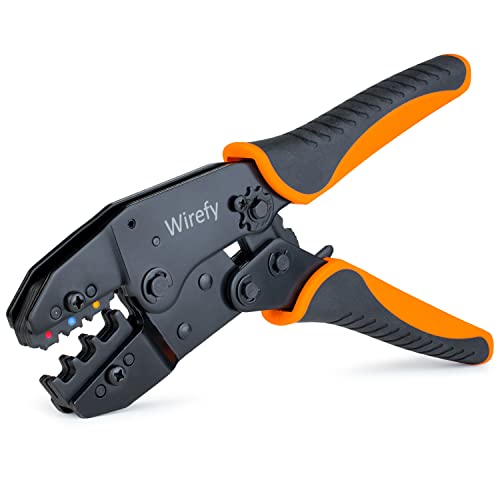
The Wirefy crimping tool for insulated connectors is a dedicated ratcheting crimper sized for one job: insulated terminals, including nylon-insulated connectors, from 22 to 10 AWG. That single-purpose focus is the point. A die shaped for insulated barrels compresses the barrel and the insulation sleeve together in one squeeze, which is what keeps a nylon or vinyl terminal from either slipping off the wire or having its insulation split by a die meant for bare metal. The ratcheting mechanism holds the terminal in the jaws while the wire is positioned, then completes a full cycle before releasing, which makes it easier to keep small terminals aligned than with a plier-style tool that has to be held closed by hand. In a lineup like this one, the Wirefy sits between the general-purpose plier crimpers and the die-change sets: it gives up the bare-terminal work the Klein 1005 covers, and it gives up the heat shrink and flag dies of the larger Wirefy set, in exchange for a lighter, simpler tool that does the most common bench task, insulated ring, spade and butt terminals in the three standard colors, with a matched die. Shops that terminate insulated connectors all day and rarely touch anything else are exactly the audience for a dedicated tool like this.
Wirefy Crimping Tool Set, 11 PCS

The Wirefy 11-piece set, model Wirefy-CRMP-AA16BB1, takes the opposite approach to a fixed-jaw tool: one 9-inch high-leverage ratcheting crimper frame and nine interchangeable crimping dies, plus a precision wire stripper in the box. The die set covers the terminal families that fixed tools split across several products, including a die for heat shrink connectors from 22 to 10 AWG, a die for heat shrink butt connectors from 22 to 8 AWG, and dies for nylon insulated, insulated flag and non-insulated terminals. That breadth matters on a bench that sees varied work in the same week, since heat shrink terminals want a gentler, wider crimp profile than vinyl insulated ones, and flag terminals will not seat in a standard die at all. The ratcheting frame gives the same full-cycle consistency as the fixed Wirefy tool, and the included stripper keeps wire preparation in the same kit. The honest cost of the format is workflow: swapping dies takes time, a loose die is a lost capability, and for a long run of identical insulated terminals a fixed-jaw ratcheter is faster to pick up and use. As one kit that covers nearly every small terminal type a repair bench encounters, though, the 11-piece set is the coverage pick.
How to choose
Start with the terminal, not the tool. Insulated vinyl and nylon terminals, heat shrink connectors, bare terminals and flag terminals each want a different die profile, and a crimp made in the wrong nest can look finished while holding almost nothing. Match the die cavity to the wire gauge range stamped on the terminal, then decide on mechanism: a full-cycle ratchet guarantees the same compression every time and is the safer choice for batches, while a plier-style crimper is faster for one-off repairs and reaches tighter spaces. Whatever the tool, tug-test every finished crimp; a correct crimp holds against a firm pull. Connection quality is also a safety issue, not just a reliability one. In 2008, the CPSC and Molex recalled about 53,000 Gardner Bender vinyl-insulated butt splices, models 10-126 and 21-126 for 12 to 10 AWG wire, because the splices could fail to hold wires together, posing shock and fire hazards. That recall covered the splices themselves, not any crimping tool, and none of the five tools above is a recalled product; it is a reminder that the joint, tool and terminal together, is what has to hold. Finally, respect the range limits: these tools top out at 10 AWG, and battery cable lugs above that need a hex or hydraulic lug crimper, a different tool class entirely.
Who should skip
Skip this class of tool if the work is crimping modular plugs or small open-barrel pins for electronics connectors, since those need dedicated dies covered by other tool types. Skip it as well if the job is heavy battery or starter cable lugs larger than 10 AWG, which need a lug crimper. And if only one or two splices a year are on the list, a basic plier-style crimper is enough; the ratcheting and die-set options earn their place through repetition.
Frequently asked questions
What is the difference between a ratcheting and a plier-style crimper?
A ratcheting crimper locks the jaws until the crimp cycle is complete, so every terminal receives the same compression and the tool physically prevents a half-finished crimp. A plier-style crimper is a simple hinged tool where hand force alone forms the joint. Ratchets give more consistent results across a batch of terminals; plier tools are faster for single repairs, reach tighter spaces, and often add a cutter.
Which crimping tool works for heat shrink connectors?
Heat shrink terminals need a die with a wider, gentler profile that compresses the barrel without cutting the adhesive-lined tubing. In this group, the Wirefy 11-piece set includes a dedicated die for heat shrink connectors from 22 to 10 AWG and another for heat shrink butt connectors from 22 to 8 AWG. After crimping, the tubing still has to be heated until the adhesive flows and seals the joint.
Can one crimping tool handle both insulated and non-insulated terminals?
Yes, but usually only the plier-style designs do both in one die head. The Klein Tools 1005 crimps insulated and non-insulated terminals from 10 to 22 AWG with marked nests for each type. Most ratcheting crimpers are built for one family, such as insulated terminals only, and die-change sets like the Wirefy 11-piece cover both families by swapping dies rather than sharing a single cavity.
Why do crimped connections pull out or overheat?
Almost every failed crimp traces back to a mismatch: the wrong die cavity for the terminal, a wire gauge outside the terminal rating, or a cycle stopped before full compression. An under-crimped barrel grips too few strands, so the wire pulls out or the joint resistance rises and heats under load. Matching the color-coded cavity to the terminal, stripping to the barrel length, and tug-testing each finished crimp prevents most failures.
Final verdict
For a mixed bench drawer, the Klein Tools 1005 is the dependable all-rounder, and the Klein Tools 3005CR is the pick when insulated terminals must come out identical every time. The Titan 11477 adds compression adjustment for mixed terminal brands, the dedicated Wirefy tool suits insulated-only work, and the Wirefy 11-piece set covers the widest range of terminal families in one kit.
Product and ASIN Reference
| Product | ASIN |
|---|---|
| Klein Tools 1005 Crimping and Cutting Tool | B0006M6Y5M |
| Klein Tools 3005CR Ratcheting Crimper | B07WMB61J5 |
| Titan 11477 Ratcheting Wire Terminal Crimper | B0069TRKJ0 |
| Wirefy Crimping Tool for Insulated Connectors | B07GFLWKTT |
| Wirefy Crimping Tool Set, 11 PCS | B092MRZ5JK |
More from Amazon
Programs that pair well with the guide above. Offers and eligibility are set by Amazon and may change.
A free business account with business pricing and bulk-buying tools for work, shop or home office.
Create a business accountFree shipping on eligible items, Prime Video and more. Eligible new members can start with a free trial.
Start a Prime free trialAudiobooks and podcasts to listen to on the go. Eligible new members can start with a free trial.
Try Audible freeAd-free music streaming. Eligible new subscribers can start with a free trial.
Try Music Unlimited freeAs an Amazon Associate we earn from qualifying purchases.
Write Your Review
No reviews yet. Be the first to share your experience!