

Key takeaways
- Compare the best server power cables for racks and PDUs, including C14 to C13, C19 and wall-plug cords with gauges, ratings and lengths checked.
A server power cable is a small part with an outsized job: if the connector family, amp rating or wire gauge is wrong, a storage array or backup server can lose power at the worst possible moment. Rack gear uses a handful of standard connector pairs, and each one exists for a different current class and a different job in the rack.
The five cords below cover the connections that show up most often around servers, NAS units and drive arrays: C14 to C13 jumpers between a PDU and a device, short color-coded rack cords, a high-current C19 cord for 20-amp circuits, and NEMA wall-plug cords for gear that sits outside the rack or feeds straight from a UPS.
As an Amazon Associate, we earn from qualifying purchases.
Quick answer
Start by matching the connector pair on your power supply and PDU: most rack gear uses C14 to C13 cords, while high-draw devices use the larger C19 and C20 pair. The Cable Matters 2-pack is the sensible default PDU jumper, the IronBox red cord suits short color-coded rack runs, and the IronBox 6-20P to C19 cord covers 20-amp circuits. Pick gauge and length after the connectors match.
Cable Matters 2-Pack Computer to PDU Power Extension Cord, 3 ft

This two-pack from Cable Matters is the workhorse entry on the list: a pair of 3-foot cords with an IEC C14 plug on one end and an IEC C13 socket on the other, which is exactly the jumper that runs from a rack PDU outlet to the inlet on a server, NAS or disk shelf. Each cord is rated at 10 amps with 18 AWG conductors and a molded SJT jacket, a specification that matches the draw of typical single-power-supply servers and storage enclosures.
The 3-foot length is the point. In a rack, excess cord becomes slack that blocks airflow and makes tracing a faulty feed harder than it should be, so a short jumper that reaches from the PDU to the device inlet without coiling is usually the right call. Getting two cords in the pack also suits the redundant-feed layout used on dual-power-supply servers, where each supply should land on a separate PDU or UPS branch.
The limits are the rating and the reach. Ten amps is fine for one device per cord, but this is not the cord for a high-draw chassis, and 3 feet will not bridge a PDU mounted at the opposite end of a tall rack. Within its class, though, it covers the most common rack connection cleanly and in pairs.
IronBox Electric Heavy-Duty C14 to C13 Power Cord, Red, 1 ft

IronBox Electric builds this cord for the shortest hop in the rack: 1 foot of 14/3 cable with a C14 plug and a C13 socket, rated at 15 amps and 250 volts. The heavier 14-gauge conductors give it more current headroom than a standard 18-gauge jumper, and the molded ends are built for gear that gets unplugged and reseated during maintenance.
The red jacket is the real feature. Color coding is how many rack builders keep A and B power feeds apart on dual-supply servers, so a red cord on one feed and a black cord on the other makes it obvious at a glance which PDU a device is drawing from before anything gets unplugged. At 1 foot, the cord also keeps the back of the rack free of the loops of slack that trap hot air around exhaust fans.
The trade-offs follow from the length and the single-cord packaging. One foot only works when the PDU sits immediately beside the device inlet, which usually means a zero-U or rear-mounted PDU in the same rack section. Anyone standardizing a full rack will be buying several. As a short, clearly marked, heavy-gauge jumper for adjacent gear, it does its one job well.
IronBox Electric 6-20P to C19 Power Cord, 12 ft

This is the high-current option in the group, built for the 208 to 240 volt circuits that feed larger servers and blade enclosures. One end carries a NEMA 6-20P straight-blade plug and the other an IEC C19 socket, with 12/3 conductors rated at 20 amps and 250 volts, and the listing states the cord is UL Listed. At 12 feet, it is also the longest cord here by a wide margin.
That combination targets a specific gap: equipment with a C20 inlet that cannot sit next to its circuit, such as a storage array on a bench during a rebuild or a server rack fed from a wall receptacle across the room. The C19 connector is the larger, heavier-duty sibling of the C13, and it only mates with C20 inlets, so there is no risk of confusing it with a standard cord during a hurried install.
Check your receptacle before ordering, because a 6-20P plug fits only a 6-20R outlet on a 20-amp, 250-volt branch circuit; it will not go into a household 5-15R or 5-20R socket. If your gear plugs into a PDU rather than a wall circuit, you want a C20 to C19 jumper instead, which is a different cord entirely.
Tripp Lite Standard Computer Power Cord, 1 ft (P006-001)

Tripp Lite’s P006-001 is the short wall-plug cord of the group: a NEMA 5-15P plug on one end and an IEC-320-C13 socket on the other, at just 1 foot long, with 18 AWG conductors and a 10-amp rating. It is a standard computer power cord in the classic sense, meant to feed a single device from a wall outlet or a UPS receptacle without leaving a coil of spare cable behind the rack.
That stubby length is useful in two common spots. The first is a UPS sitting directly under or beside a NAS or backup server, where a full-length cord just becomes clutter. The second is a workbench, where drives and enclosures rotate through data recovery and imaging jobs and a short cord stays out of the way of the next device in line.
The obvious limit is reach: 1 foot assumes the outlet is essentially touching the equipment, and the 10-amp ceiling suits one modest device rather than a loaded chassis. Tripp Lite sells this same cord family in longer lengths, so treat the P006-001 as the close-quarters member of the set. For a device parked right next to its power source, it keeps the setup tidy and the rating honest.
Tripp Lite Standard Computer Power Cord, 6 ft, Left-Angle C13 (P006-006-13LA)
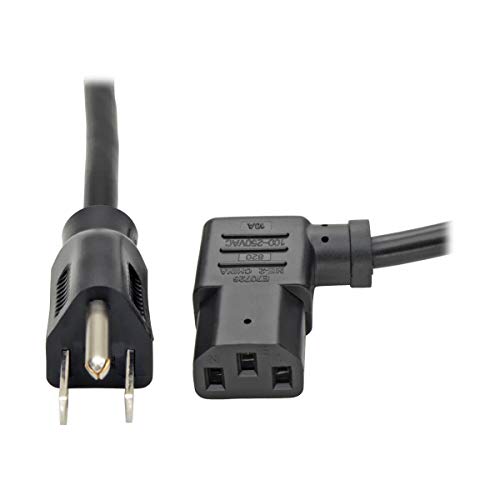
The P006-006-13LA takes the same standard formula as its shorter sibling and solves a different problem: the C13 socket is molded at a left angle instead of pointing straight back. It runs 6 feet, carries a NEMA 5-15P plug on the wall end, and is rated at 10 amps over 18 AWG conductors, matching the standard computer power cord specification.
An angled socket matters when equipment has to sit close to a wall or the back panel of a shallow rack. A straight C13 forces the cable to bend sharply right at the connector, which strains the molded end over time and pushes the device forward; the left-angle exit lets the cord drop or run sideways immediately, so servers and monitors can sit nearly flush. Six feet is enough reach for a desk-side tower server, a bench NAS or a printer across the room corner.
Like the P006-001, this is a 10-amp cord for individual devices, not a substitute for a 14-gauge PDU jumper on a loaded rack rail. It also assumes a North American 5-15R outlet. For a single server or storage box that lives tight against a wall, the angled end is a small detail that prevents a slow, predictable failure.
How to choose
Match the connector pair first. The device inlet and the PDU or outlet decide everything: C14 plugs pair with C13 sockets for the 10 to 15 amp class, and C20 plugs pair with C19 sockets for 20-amp gear. The two families do not interchange, so read the inlet on your power supply before ordering anything.
Next, check the amp rating against the power supply. A cord should be rated at or above the draw of the device it feeds, and heavier wire, meaning a lower AWG number, carries more current with less heat. Fourteen-gauge cords are the safer default for loaded servers, while 18-gauge cords suit single modest devices.
Then buy length for the rack you actually have. Short jumpers between a PDU and the device below it keep airflow clear and make feeds easy to trace; longer cords belong on bench gear and wall-fed equipment. Finally, consider color coding for redundant feeds and a recognized safety listing such as UL, since a power cord is the last place to accept unmarked construction.
Who should skip
Skip this list if you need C20 to C19 jumpers between a high-end PDU and blade chassis as your main purchase, since only one pick here terminates in a C19 and it is a wall-plug cord, not a PDU jumper. Skip it as well if your racks run on non-North-American outlets, because two picks use NEMA plugs. And if you need locking connectors that resist vibration and accidental pulls, none of these standard molded cords is the right tool.
FAQ
What is the difference between C13 and C19 power cords?
The C13 socket pairs with a C14 inlet and belongs to the 10 to 15 amp class used by most servers, NAS units and network gear. The C19 socket pairs with a C20 inlet and is physically larger, built for the 20-amp class found on high-draw servers and blade enclosures. The two sizes do not mate with each other.
Can a 10-amp cord feed any server power supply?
Only if the power supply’s actual draw stays within the cord’s rating at your supply voltage. A small NAS or a single efficient server usually sits comfortably under 10 amps, but a fully loaded dual-processor chassis can exceed it. Read the rating label on the power supply and choose a cord rated at or above that figure.
Why do rack power cables come in colors like red?
Color is a labeling system. On servers with two power supplies, each supply should feed from a different PDU or UPS branch, and using red cords on one branch and black on the other makes the split visible at a glance. That prevents the classic mistake of unplugging both feeds during maintenance and dropping the machine.
Does wire gauge matter on a short rack cord?
Yes, although length changes the math. A lower AWG number means thicker conductors, which run cooler and drop less voltage under load. On a 1 or 3 foot jumper the effect is small, but gauge still sets the cord’s amp rating, and that rating, not the length, is what has to cover your device’s draw.
Final verdict
For most racks, the Cable Matters 2-pack covers the everyday PDU-to-server jumper, and the IronBox red cord adds a short, color-coded, heavier-gauge option for redundant feeds. The IronBox 6-20P to C19 cord is the pick for 20-amp wall circuits, while the two Tripp Lite cords handle the bench and wall-outlet jobs, with the left-angle model solving tight clearances. Match connectors and ratings first, and any of the five will serve reliably.
Product and ASIN Reference
| Product | ASIN |
|---|---|
| Cable Matters 2-Pack Computer to PDU Power Extension Cord, 3 ft | B01CH260AW |
| IronBox Electric Heavy-Duty C14 to C13 Power Cord, Red, 1 ft | B00CEYWU1W |
| IronBox Electric 6-20P to C19 Power Cord, 12 ft | B07BZGZH6W |
| Tripp Lite Standard Computer Power Cord, 1 ft (P006-001) | B00FBA1U6M |
| Tripp Lite Standard Computer Power Cord, 6 ft, Left-Angle C13 (P006-006-13LA) | B003MGB1EI |
More from Amazon
Programs that pair well with the guide above. Offers and eligibility are set by Amazon and may change.
A free business account with business pricing and bulk-buying tools for work, shop or home office.
Create a business accountFree shipping on eligible items, Prime Video and more. Eligible new members can start with a free trial.
Start a Prime free trialAudiobooks and podcasts to listen to on the go. Eligible new members can start with a free trial.
Try Audible freeAd-free music streaming. Eligible new subscribers can start with a free trial.
Try Music Unlimited freeAs an Amazon Associate we earn from qualifying purchases.

Write Your Review
No reviews yet. Be the first to share your experience!