

Key takeaways
- Compare the best helping hands tools for soldering and PCB repair, from classic clip stands to magnetic-arm stations with magnifying lamps and LED light.
Board-level repair work rarely fails because of the iron. It fails because the board moved. Swapping components on a drive PCB, reattaching a torn connector, or holding two fine wires together for a splice all demand a third hand that never gets tired and holds the workpiece at exactly the angle you set. Helping hands tools fill that role, ranging from a simple cast-iron clip stand to magnetic-arm stations with built-in magnifying lamps. This guide compares five current models, focusing on arm type, clamp style, base stability, and magnification.
As an Amazon Associate, we earn from qualifying purchases.
Quick answer
For most repair benches, the QuadHands Classic is the strongest all-round helping hands tool, with steel gooseneck arms and locking stainless clamps on a heavy powder-coated base. The KOTTO four-arm station covers the same jobs for less bench space, while the NOEVSBIG and XYK stations add magnetic arms and lit magnification. The NEIKO 01902 remains the compact classic for light work.
QuadHands Classic Workbench Helping Hands (QH4)

The QuadHands Classic, model QH4 from Alphidia, is the heavy-duty end of the helping hands category. Four steel gooseneck arms thread down through the powder-coated steel base and into the rubberized feet, so the arms are anchored by the full weight of the unit rather than sitting on top of it. Each arm ends in a stainless steel alligator clamp that rotates to the angle you need and locks with a thumb nut, adjusted by hand with no tools. Four soft silicone clamp covers are included, which matters when the jaws close on a populated board or a lacquered wire: the covers spread the bite and reduce the chance of scarring a trace or crushing insulation.
The base is powder-coated steel with rubber feet, and the whole unit is made in the USA at the maker’s Charleston, South Carolina facility. There is no magnifier and no light on this model, so it pairs with a separate bench lamp or microscope rather than replacing one. The tradeoff for the anchored arms is repositioning: moving an arm to a new spot means unthreading and re-seating it, which is slower than sliding a magnetic arm across a plate. For a fixed repair bench where the same holding pattern repeats all day, that stability-first design is the point.
KOTTO Helping Hands Soldering, Four Arms

The KOTTO four-arm station follows the same gooseneck layout in a lighter, simpler package. Four adjustable metal gooseneck arms rise from a non-slip steel weighted base, each tipped with a stainless steel alligator clip. The clips rotate a full 360 degrees, so a board or wire bundle can be rolled over for underside work without releasing the grip and starting again. The listing frames it as a PCB holder for soldering, assembly, jewelry, and hobby work, which matches its real strength: holding small boards, connectors, and loose components steady while both of your hands stay on the iron and the solder.
There is no magnifier or lamp built in, and the listing does not state a base weight or arm length, so those figures are not claimed here. What it does state is the weighted, non-slip base, the feature that separates usable helping hands from tippy novelty versions. If your bench already covers lighting and magnification with a microscope or lamp, this is the straightforward four-clip holder to add, and its smaller footprint suits crowded benches.
NOEVSBIG Magnetic Helping Hands with Magnifying Desk Lamp (N-6PC-5B)
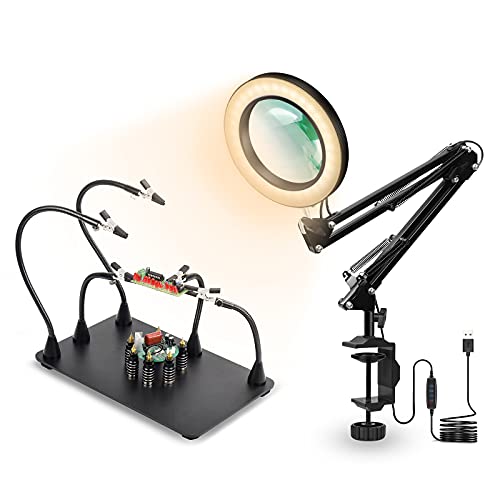
The NOEVSBIG station, part number N-6PC-5B, is built around a powder-coated steel base plate measuring 11.4 by 7.1 inches and weighing 3.3 pounds. Five flexible metal gooseneck arms with magnetic bases attach anywhere on that plate: two arms are 11 inches long and three are 4.7 inches, each ending in a stainless steel alligator clamp that rotates 360 degrees and locks with a thumb nut. Six magnetic pillar holders are also included, which pin a circuit board flat against their shoulders instead of gripping it by the edges, a gentler hold for boards you do not want clamped.
The built-in lamp is the headline feature. Its real glass lens is 5-diopter, giving 2.25X magnification across a 4.13-inch diameter, ringed by 72 SMD LEDs with three color modes spanning 3500K to 6500K and stepless dimming. The lamp runs on USB power at 5 volts and 2 amps, drawing 10 watts. One caution specific to this audience: the arms and pillars are magnetic, so keep the base plate and loose pillars away from exposed platters, tape media, and the outside of a drive you are about to image, and treat it as a soldering-side tool rather than a drive-handling one.
XYK Magnetic Helping Hands Soldering Station

The XYK station takes a similar magnetic approach with a slightly smaller plate. Its powder-coated steel base measures 10 by 7.48 inches with anti-slip rubber pads underneath, and the unit weighs 2 kilograms. Four metal magnetic gooseneck arms are included, two at 9.4 inches and two at 9 inches, each with an alligator clip that rotates 360 degrees and locks in place. The clips carry rubber sleeves, which the listing notes protect polished surfaces and help prevent short circuits when a clip bridges adjacent contacts. Four magnetic PCB pillars hold a board by its face rather than its edges.
Magnification comes from a 3X lamp on its own magnetic gooseneck, so the lens can be parked anywhere on the base or moved aside entirely. The lamp uses 28 lamp beads rated at 500 lumens with six brightness levels. Because the lamp, arms, and pillars all attach magnetically, the whole layout can be rearranged in seconds when you move from a full-size board to a single connector, and unused pieces can be lifted off the plate to clear space. As with the NOEVSBIG, the magnetic hardware should stay on the soldering side of the bench, well away from opened drives and loose media.
NEIKO 01902 Adjustable Helping Hand with Magnifying Glass
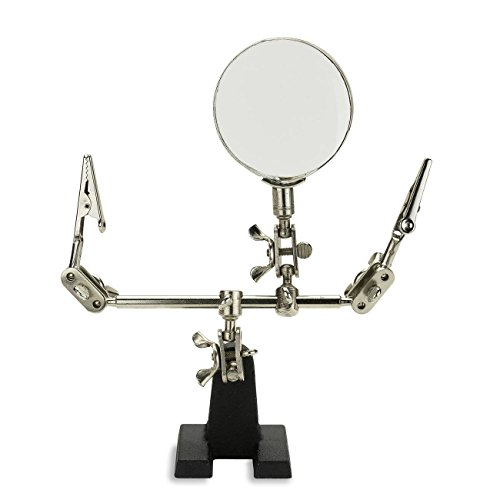
The NEIKO 01902 is the classic helping hand in its original form, model 1902, and it is still the right answer for light, occasional work. Two alligator clips sit on adjustable arms over a heavy cast-iron base, with a 2X magnifying glass mounted on its own adjustable arm between them. The chrome-finished unit weighs 11.3 ounces and measures 5 by 3 by 2.68 inches, so it takes up almost no bench room and can live in a drawer between jobs. The manufacturer is Ridgerock Tools Inc., and the design has been sold in this form for many years.
The limits are honest ones. Two clips hold one small item, not a full board plus a wire plus a connector, and the small base can tip if a clip is loaded far off center. The 2X lens is enough for reading markings and checking joints on through-hole work, but it is not a substitute for a microscope on fine surface-mount repairs. What you get in return is simplicity: no arms to arrange, no lamp to power, nothing to assemble beyond positioning the clips. For tinning wires, holding a connector body, or steadying a small switch during a quick repair, it does the job it has always done.
How to choose
Start with the arm system. Threaded or fixed gooseneck arms, like the QuadHands and KOTTO designs, hold their position under load and never slide, but repositioning is slow. Magnetic arms, like the NOEVSBIG and XYK stations, rearrange in seconds and accept extra pillars, but a hard knock can shift them, and the magnets are a genuine bench-discipline issue around magnetic media: never set an opened drive, a bare platter, or backup tapes on or near a magnetic base plate.
Next, match the clamp to the work. Bare alligator clips grip hard and can scar a board edge; silicone or rubber clip covers spread the pressure. Pillar holders support a board by its face and are the gentlest option for populated boards. Then weigh the base: a heavy steel or cast-iron base that stays planted when an arm is bent outward is worth more than extra arms on a light base. Finally, decide on magnification. A built-in lit lens in the 2X to 3X range covers inspection and through-hole work; fine surface-mount repair still belongs under a microscope, with the helping hands simply holding the board. No CPSC recall covering these five models could be verified, so check the exact model number against the CPSC database before any large purchase.
Who should skip
Skip helping hands entirely if your board work is mostly large desktop or server boards: a rotating PCB vise or frame holder supports a big board along its edges far better than clips can. Skip the magnetic stations if your bench handles opened drives and loose media all day and you cannot keep the two work areas separated; a fixed-arm model removes the risk. Skip the classic two-clip stands if you routinely hold a board, a connector, and a wire at once, since two clips run out immediately. And if your close work is fine-pitch surface-mount rework, put the money toward a microscope first; magnification on a stalk is an inspection aid, not a rework tool.
FAQ
What are helping hands used for in electronics repair?
They hold a board, wire, or connector steady at a set angle so both of your hands stay free for the soldering iron and solder. In board-level repair that means holding a drive PCB while a capacitor is swapped, keeping two wires aligned for a splice, or presenting a connector at the angle where its pins can be reflowed without the part skating across the bench.
Are magnetic helping hands safe around hard drives?
The magnets in these arms and pillars are strong enough to pin hardware to a steel plate, so treat them like any other bench magnet: keep them away from exposed platters, tape media, and floppy media, and never rest an opened drive on the base plate. Used on the soldering side of the bench, with drives kept at a distance, they are a normal repair tool rather than a hazard.
Helping hands or a PCB vise: which is better?
They solve different problems. A vise or frame holder grips a board along its edges and supports it evenly, which suits long soldering sessions on one board. Helping hands grip small parts, wires, and connectors at odd angles a vise cannot reach. Many benches keep both: the vise for the board itself, the helping hands for everything that has to meet the board mid-repair.
How much magnification do I need for PCB work?
For through-hole work and general inspection, the 2X to 3X lenses built into these stations are enough to read component markings and check joint quality. Fine surface-mount work, such as inspecting small-pitch pins or hunting for solder bridges, needs more magnification and a longer working distance than a stalk-mounted lens provides, which is where a bench microscope takes over.
Final verdict
Buy the QuadHands Classic if you want the most stable fixed-arm holder and already own a lamp or microscope. Choose the NOEVSBIG if you want the fullest station, with five magnetic arms, board pillars, and a dimmable glass-lens lamp in one unit, or the XYK for the same magnetic layout on a smaller plate. The KOTTO is the simple four-arm pick for a crowded bench, and the NEIKO 01902 is the compact classic for light, occasional jobs. Whichever you pick, keep magnetic models away from exposed media.
Product and ASIN Reference
| Product | ASIN |
|---|---|
| QuadHands Classic Workbench Helping Hands (QH4) | B00GIKVP5K |
| KOTTO Helping Hands Soldering, Four Arms | B07MDKXNPC |
| NOEVSBIG Magnetic Helping Hands with Magnifying Desk Lamp (N-6PC-5B) | B092ZPFRRR |
| XYK Magnetic Helping Hands Soldering Station | B0CNVMKT3X |
| NEIKO 01902 Adjustable Helping Hand with Magnifying Glass | B000P42O3C |
More from Amazon
Programs that pair well with the guide above. Offers and eligibility are set by Amazon and may change.
A free business account with business pricing and bulk-buying tools for work, shop or home office.
Create a business accountFree shipping on eligible items, Prime Video and more. Eligible new members can start with a free trial.
Start a Prime free trialAudiobooks and podcasts to listen to on the go. Eligible new members can start with a free trial.
Try Audible freeAd-free music streaming. Eligible new subscribers can start with a free trial.
Try Music Unlimited freeAs an Amazon Associate we earn from qualifying purchases.

Write Your Review
No reviews yet. Be the first to share your experience!