

Key takeaways
- Compare the best contour gauges for copying irregular shapes, from locking 10-inch duplicators and two-piece sets to a compact 6-inch profile gauge.
Fitting flooring, tile or trim around pipes, door casings and curved walls usually fails at the measuring stage, not the cutting stage. A contour gauge solves that problem by pressing a row of sliding teeth against an irregular shape, locking the profile in place, and transferring the exact outline onto the material about to be cut. This guide compares five contour gauges sold on Amazon, covering the popular 10-inch locking duplicators, two-piece sets that add a smaller 5-inch gauge, and one compact 6-inch model from a long-established tool brand. The right choice depends on profile width, tooth depth, and whether the gauge can lock its shape.
As an Amazon Associate, we earn from qualifying purchases.
Quick answer
For most flooring and tile work, a 10-inch locking contour gauge such as the Saker covers the widest range of profiles in a single pass. Buyers who regularly switch between large and small shapes should look at the two-piece Acari Designs or Cheval Tools sets, while the compact General Tools 837 suits moldings, pipes and smaller trim profiles.
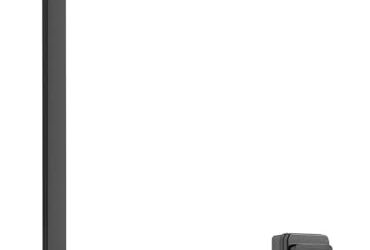
Saker Contour Gauge Profile Tool, 10 Inch

The Saker contour gauge is the listing most buyers picture when they search for this tool category: a 10-inch profile duplicator in black ABS plastic with an adjustable lock. Pressing the gauge against a shape pushes its pins into an exact copy of the profile, and the locking mechanism holds those pins in place while the outline is traced onto tile, laminate, carpet or flooring. A small wrench adjusts pin tightness, so the resistance can be set firmer for heavy profiles or looser for delicate trim. The listing describes the body as high-quality ABS plastic, which keeps the tool light and avoids scratching finished surfaces during the copy. Ten inches of width handles most door casing, pipe and baseboard profiles in one pass, without stitching together two overlapping copies. The Saker suits DIY renovators who want one straightforward gauge for flooring and tile work, and its adjustable tension is a practical advantage over fixed-tension budget gauges whose pins either drift or need excessive force. Buyers working mainly on small moldings may find the 10-inch body wider than necessary, but as a single all-purpose contour gauge for home improvement, this is the most direct option in the group.
Acari Designs Contour Gauge with Lock Set, 10 Inch and 5 Inch

The Acari Designs set pairs a 10-inch contour gauge with a 5-inch version, both fitted with metal locks. The lock and core are reinforced aluminum alloy, while the wide body and ruler are ABS plastic, a combination the listing positions as more durable than all-plastic locking tabs. The body is extra wide at 5.1 inches, and the stated overall sizes are 13.14 by 5.1 by 0.8 inches for the larger gauge and 7.2 by 5.1 by 0.8 inches for the smaller one, giving the teeth more depth for chunky profiles such as stone hearths and thick trim. Acari states the teeth resolve detail down to 1/16 of an inch, and the pin tension is pre-calibrated at the factory, so there are no small screws or hex keys to adjust before use. The bright orange color makes the tool easy to spot in a crowded toolbox. The listing, part number CG1, also states a lifetime manufacturer guarantee. This set fits buyers who alternate between wide flooring profiles and tight corners, and who want a metal lock that keeps the copied shape secured during transfer. The trade-off is a bigger, heavier package than a single-gauge purchase.
Lambor Studios Contour Gauge, 10 Inch Widen, Red
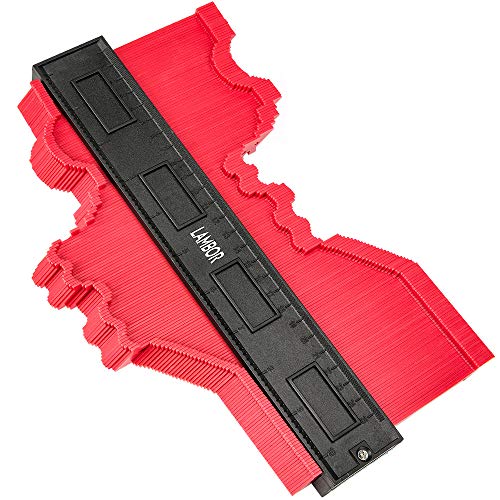
The Lambor Studios contour gauge takes the widened-body approach in a single 10-inch tool. The listing gives overall dimensions of 11 by 6 by 0.7 inches and a weight of 14 ounces, and the body carries both inch and centimeter graduations on both sides, so the copied profile can be checked against a scale without reaching for a separate ruler. Construction is high-strength ABS plastic, described as rustproof and durable, which matters for a tool that gets pressed against damp subfloors, masonry and metal ductwork. Lambor Studios positions the gauge for winding pipes, circular frames, ducts, tiles, laminate, carpet, molding and car body panels, a broader spread of uses than flooring-only listings. The widened format records deeper cross-sections in one press, helpful on crown molding and irregular stone edges where a narrow gauge runs out of tooth travel. The red finish is easy to find among offcuts and tools on a job site. Buyers who measure in metric as often as in inches get the most from the dual graduations. The listing does not highlight a locking feature as strongly as the Saker or Acari models, so careful handling between copy and trace is advisable.
Cheval Tools Contour Gauge Set, 10-Inch Widened and 5-Inch

The Cheval Tools set combines a 10-inch widened contour gauge with a 5-inch gauge in one package, covering the two sizes most renovation work calls for. The widened 10-inch tool is intended to copy deeper angles and taller profiles than a standard-width gauge, while the 5-inch companion handles short runs around pipes, outlets and trim returns where a long body cannot sit flat against the work. Like the other duplicators in this guide, the gauges work by pressing the teeth against the shape, then transferring the captured outline to flooring, trim, tile or pipe insulation for marking and cutting. A two-piece set removes the compromise of forcing one size onto every job: wide profiles get a single clean copy, and small profiles get a gauge that is easier to control with one hand. Cheval Tools pitches the set at DIY enthusiasts as a general measuring tool for the home workshop. Buyers who already own a satisfactory 10-inch gauge gain less here, but as a first purchase the set covers more situations than either size alone. The listing is lighter on published specifications than the Acari set, so buyers comparing fine detail should weigh the stated sizes rather than tooth resolution claims.
General Tools Contour Gauge 837, 6 Inch

The General Tools 837 is the traditional entry in this group: a 6-inch contour gauge from an established American tool brand. Its design uses a row of long, thin, moveable teeth held in a perpendicular housing, which takes an impression of the surface being copied. The listing notes that it fits around most pipes and round columns, and that copied shapes transfer to tile, laminate, engineered wood, solid wood and vinyl for precise flooring cuts. At 6 inches it is the shortest gauge here, which limits it on wide baseboard profiles but makes it the most manageable option for moldings, spindles and small trim work, and the easiest to keep in a tool belt or apron pocket. General Tools has made specialized woodworking and layout tools for many years, and the 837 follows the classic metal-era pattern of the category rather than the widened plastic format of newer duplicators. It carries no locking mechanism in the listing description, so the copied profile should be traced promptly and the gauge handled flat. For buyers who value a compact, proven design over maximum width, the 837 remains a sensible pick.
How to choose
Start with profile width. Most door casings, pipes and baseboards fit within a 10-inch gauge, while small moldings and trim returns are easier with a 5 or 6-inch tool, which is why two-piece sets exist. Next, consider tooth depth: widened bodies, such as the Acari and Lambor Studios designs, carry longer teeth that capture taller, deeper profiles in one press. A locking mechanism matters whenever the gauge must be carried across a room before tracing, because unlocked pins shift with the slightest knock; adjustable tension, as on the Saker, adds control over how firmly the teeth hold. Markings are a smaller but real factor: the Lambor Studios gauge prints inch and centimeter scales on both sides, useful when a cut list mixes unit systems. Material is mostly ABS plastic in this category, which protects finished surfaces, while the Acari set adds an aluminum alloy lock and core for durability. Finally, match the gauge to the material being cut: flooring and tile installers need width and a lock, woodworkers copying moldings need fine teeth and a compact body, and anyone tracing profiles onto metal or masonry benefits from a wide, deep gauge.
Who should skip
Contour gauges copy shapes; they do not measure dimensions, so anyone who needs numeric measurements for machining or metal fabrication should use calipers, radius gauges or a digital profile scanner instead. They are also the wrong tool for profiles longer than the gauge body when an exact single-pass copy is critical, since overlapping two copies introduces error. Renters planning one small flooring repair may find a cardboard template adequate. And buyers expecting a gauge to mark soft or crumbly surfaces should note that the teeth need a firm edge to register against.
FAQ
What is a contour gauge used for?
A contour gauge copies the outline of an irregular shape, such as a pipe, door casing or curved wall, so the outline can be traced onto tile, flooring, laminate or trim and cut to fit. The teeth slide to match the profile, and on locking models the shape stays fixed during transfer.
What size contour gauge should I buy?
A 10-inch gauge covers most household profiles, including door casings and baseboards, in a single pass. A 5 or 6-inch gauge is easier to control on moldings, pipes and short trim pieces. Two-piece sets pair both sizes and suit buyers whose projects vary widely in scale.
Do contour gauges work on tile and laminate?
Yes. The standard workflow is to press the gauge against the obstruction, lock or hold the copied shape, trace the outline onto the tile or laminate plank, and then cut along the traced line. ABS plastic teeth will not scratch glazed tile or finished flooring during the copy.
How do I stop the copied shape from shifting?
Choose a gauge with a lock and engage it before moving the tool, then carry the gauge flat and trace promptly. Models with adjustable pin tension can be set firmer for transport. Without a lock, even a light knock against a bench edge can move the teeth and spoil the copy.
Final verdict
The Saker 10-inch gauge is the simplest recommendation for general flooring and tile work, thanks to its lock and adjustable pin tension. The Acari Designs set is the better buy for varied projects, pairing two sizes with a metal lock, a wide body and stated fine tooth resolution. The Lambor Studios gauge adds dual-unit graduations, Cheval Tools offers a straightforward two-size set, and the General Tools 837 remains the compact classic for moldings and pipes. Match width and locking to the profiles you copy most, and any of the five will outperform paper templates.
Product and ASIN Reference
| Product | ASIN |
|---|---|
| Saker Contour Gauge Profile Tool, 10 Inch, Black | B08H1R9NMR |
| Acari Designs Contour Gauge with Lock Set, 10 Inch and 5 Inch | B08HXJ351J |
| Lambor Studios Contour Gauge, 10 Inch Widen, Red | B07YB599F1 |
| Cheval Tools Contour Gauge Set, 10-Inch Widened and 5-Inch | B087J9CKDJ |
| General Tools Contour Gauge 837, 6 Inch | B00004T7RA |
More from Amazon
Programs that pair well with the guide above. Offers and eligibility are set by Amazon and may change.
A free business account with business pricing and bulk-buying tools for work, shop or home office.
Create a business accountFree shipping on eligible items, Prime Video and more. Eligible new members can start with a free trial.
Start a Prime free trialAudiobooks and podcasts to listen to on the go. Eligible new members can start with a free trial.
Try Audible freeAd-free music streaming. Eligible new subscribers can start with a free trial.
Try Music Unlimited freeAs an Amazon Associate we earn from qualifying purchases.


Write Your Review
No reviews yet. Be the first to share your experience!