

Key takeaways
- Compare the best soldering stations for electronics and drive board repair, with verified wattage, temperature range, stability, tip and ESD safety specs.
A soldering station is the tool that decides whether a board-level repair ends with a recovered drive or a lifted pad. Swapping a failed controller chip, replacing a shorted protection diode, or moving a ROM to a donor board all call for heat that arrives fast, holds steady, and stays where the display says it is. A base station with closed-loop temperature control delivers that in a way a basic plug-in iron cannot. The five stations below are all soldering-only units, distinct from standalone irons and from the hot air rework stations a recovery bench pairs them with, and they cover established bench brands, high-value digital units, and one complete starter kit.
As an Amazon Associate, we earn from qualifying purchases.
Quick answer
For most electronics benches, the Hakko FX-888D is the safest long-term buy, with temperature stability of one degree and a deep tip catalogue. The Weller WE1010NA adds a temperature lock and standby mode for shared benches. The YIHUA 939D+ and 926 III cover the value end, and the Aoyue 937+ suits lighter boards and tight spaces.
Hakko FX-888D Digital Soldering Station

The FX-888D is the station that shows up on professional benches more than any other in this group, and its listing specs explain why. Temperature stability is rated at plus or minus 1.0 degrees Celsius (1.8 degrees Fahrenheit), the tightest figure here, and the upper temperature rating is 899 degrees Fahrenheit, which covers lead-free work on multilayer boards with heavy ground pours. The display is an LCD with push-button adjustment, and the set temperature can be locked so a shared bench keeps its settings. The handpiece is the FX-8801, a light iron that draws on the T18 tip family, one of the widest tip catalogues in bench soldering: fine conical tips for small packages, chisel tips for through-hole joints, and bevel tips for larger terminals. The station weighs 2.6 pounds, so it stays put without dominating a crowded recovery bench. For data recovery work, the relevant point is control at the low end: removing a shorted protection diode or reworking a connector on a drive PCB rewards a station that does not overshoot while the tip dwells on a small pad. The FX-888D is a soldering-only station, so it pairs with, rather than replaces, a hot air station on the same bench.
Weller WE1010NA Digital Soldering Station
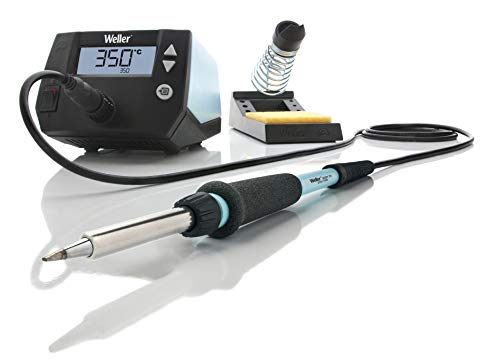
The WE1010NA is Weller’s 70 watt digital station, built around the WEP70 handpiece and the ET tip family. Its listing rates temperature stability at plus or minus 4 degrees Fahrenheit (2 degrees Celsius), and the feature set is aimed at benches where settings must not drift between operators: a temperature lock holds the chosen set point, a standby mode drops the tip temperature when the iron sits idle, an auto setback conserves energy, and the menu can be password protected to preserve settings. The included ETA tip is a 1.6 millimeter screwdriver profile, a sensible default for through-hole work and larger surface-mount pads, and the PH70 safety rest ships in the box with a cleaning sponge. The station runs on 120 volt mains and carries a one year warranty. Seventy watts puts it level with the strongest units here for thermal recovery, which matters when a joint ties into a ground plane on a donor board and a weaker iron would sit there cooking the pad while the solder refuses to flow. What it does not include is kit clutter: there are no helping hands, solder, or spare tips beyond the single fitted ETA, so budget for consumables separately. For a recovery lab standardizing one station across several benches, that spareness is arguably the point.
YIHUA 939D+ Digital Soldering Station

The 939D+ is YIHUA’s transformer-based bench station, rated at 75 watts equivalent with a temperature range of 392 to 896 degrees Fahrenheit, shown on a digital display that toggles between Celsius and Fahrenheit. The built-in transformer is the detail that matters for electronics work: it isolates the handpiece from mains, and the station is specified as ESD safe, which is the baseline requirement before an iron touches a drive controller board. The front panel is aluminum and resists burns from a carelessly parked iron, a small thing that keeps a busy bench tidy over years of use. The box includes extra soldering tips and lead-free solder, so it arrives closer to ready than the Weller, and replacement handpieces are listed under the same model line, including the 907F handpiece. On a recovery bench it fills the role of the second station: hot enough for lead-free joints on modern boards, controlled enough for connector rework, and inexpensive enough in consumables that a worn tip is a trivial swap rather than a purchasing decision. Benches that already own a premium iron will find it a sensible always-on spare; benches buying their first real station will find the isolation and ESD specification are the reasons to choose it over cheaper unbranded units.
YIHUA 926 III Soldering Iron Station Kit
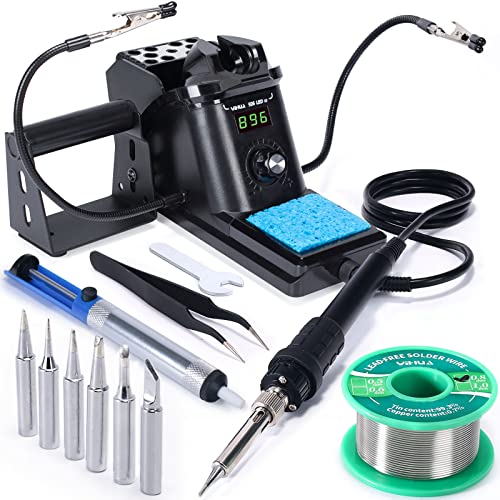
The 926 III is sold as a complete kit rather than a bare station. The station itself is a 60 watt unit with a digital display, auto sleep, calibration support, and a Celsius and Fahrenheit conversion switch. Around it, the box adds two helping hands, six extra iron tips, a roll of lead-free solder, a solder sucker, and stainless steel tweezers: the full set of small tools a first bench needs before it can do anything at all. For a data recovery operation equipping a satellite bench or a training seat, that completeness is the argument: one box, no separate accessory order, and a station whose sleep function protects tips when a trainee walks away mid-job. The trade-offs are equally clear. Sixty watts is the joint lowest output here alongside the Aoyue, so large ground planes will test its recovery, and the bundled accessories are starter grade rather than the items an experienced technician would choose individually. Treat it as a capable station with a useful toolkit attached, not the other way round, and it earns its place. It is also the natural recommendation when the buyer genuinely does not yet know which consumables their work needs, because the kit answers that question by including a sample of everything.
Aoyue 937+ Pro Series Soldering Station

The 937+ is the compact option: a 45 watt station whose listing puts its temperature range at 200 to 480 degrees Celsius (392 to 897 degrees Fahrenheit), set through a knob with a digital readout rather than buttons. Two design choices suit it to board work. The iron runs on a 24 volt output, which limits the energy a fault can deliver into the circuit on the bench, and a vibration sensor in the handle wakes the station from sleep when it is picked up, then lets it idle back down when parked, extending tip life. A spare plug-in ceramic heating element is included in the box, so the most common wear failure becomes a minutes-long swap instead of a return shipment. The station is ESD safe, switches between Celsius and Fahrenheit, offers a programmable digital offset for calibration, a system lockout feature to keep settings from wandering, and a configurable iron holder that can be arranged to suit the bench layout. At 45 watts it is the pick for fine work: small packages, connector pins, and jumper wires on drive boards, rather than heavy terminals. Labs that mostly desolder large through-hole parts or fight big ground planes should look at the 70 watt class above instead.
How to choose
Wattage is really about recovery. A station’s rating describes how fast the tip returns to temperature after a joint pulls heat out of it, so match the class to the boards: 45 to 60 watts handles most surface-mount and light through-hole work, while 70 watts and up earns its keep on multilayer boards and ground planes. Temperature stability matters more than the headline range; every station here covers lead-free temperatures, but the ones rated within a degree or two hold a small pad at set point without cooking it. ESD safety is not optional around drive electronics: choose a station specified as ESD safe, with the iron isolated or grounded, and run it alongside the bench mat and wrist strap from the same setup. Tip ecosystem decides long-term cost, so favor stations whose tip family is broad and still in production. One safety distinction is worth stating plainly. Unbranded clone stations in the classic 936 shape have documented mains wiring faults, including live voltage present at the handpiece connector and switches that interrupt the neutral instead of the line. None of the five stations above is such a clone, and none is subject to a recall we could identify; still, buy through the maker’s official storefront, confirm the listing voltage matches local mains before ordering, since several of these models also ship in 220 volt versions, and run the station on a protected circuit.
Who should skip
Skip the station format entirely if your soldering is limited to occasional cable splices and battery leads: a basic temperature-controlled iron covers that work for less money and less bench space, and a station’s control unit will sit idle. Skip these five if your rework is mostly hot air work on larger packages; a dedicated hot air station, or a 2 in 1 combo unit, is the right tool there. And skip the kit-style bundle if you already own quality tweezers, helping hands, and consumables: a bare station from Hakko or Weller puts the whole budget into the iron itself.
FAQ
What temperature should I set for work on hard drive boards?
Most drive PCB joints flow comfortably in the middle of these stations’ ranges: around 320 to 350 degrees Celsius for leaded solder and 350 to 380 degrees for lead-free. Use the lowest setting that melts the joint promptly, keep dwell time short, and let wattage, not extra heat, do the work on ground planes.
Why does ESD safety matter for a soldering station?
A drive’s controller and preamp circuits can be damaged by static discharges too small to feel. An ESD safe station keeps the tip at a controlled potential and isolates it from mains, so the iron itself never becomes the discharge path. It only works as part of a grounded setup that includes a mat and a wrist strap.
What is the difference between a soldering station and a soldering iron?
A standalone iron carries what control it has in the handle and plugs straight into the wall. A station puts closed-loop temperature sensing and control in a base unit, so tip temperature is measured continuously and held at the set point. For board repair, that control is the difference between repeatable joints and guesswork.
How do I make soldering tips last longer?
Keep tips tinned: coat the working face with fresh solder before parking the iron, and let sleep or standby modes drop the temperature when idle, as several stations here do automatically. Clean on a brass sponge rather than a wet one to avoid thermal shock, and never file a plated tip to reshape it.
Final verdict
For a primary recovery bench, the Hakko FX-888D sets the standard here: the tightest temperature stability, a proven handpiece, and a tip catalogue that covers everything from fine work to heavy terminals. The Weller WE1010NA is the equal choice where settings must stay locked across operators. The YIHUA 939D+ brings transformer isolation and ESD safety to the value tier, the 926 III equips a new bench in one box, and the Aoyue 937+ remains the compact pick for fine board work.
Product and ASIN Reference
| Product | ASIN |
|---|---|
| Hakko FX-888D Digital Soldering Station | B00ANZRT4M |
| Weller WE1010NA Digital Soldering Station | B077JDGY1J |
| YIHUA 939D+ Digital Soldering Station | B07RVMZNYR |
| YIHUA 926 III Soldering Iron Station Kit | B082F1WKP9 |
| Aoyue 937+ Pro Series Soldering Station | B000I30QBW |
More from Amazon
Programs that pair well with the guide above. Offers and eligibility are set by Amazon and may change.
A free business account with business pricing and bulk-buying tools for work, shop or home office.
Create a business accountFree shipping on eligible items, Prime Video and more. Eligible new members can start with a free trial.
Start a Prime free trialAudiobooks and podcasts to listen to on the go. Eligible new members can start with a free trial.
Try Audible freeAd-free music streaming. Eligible new subscribers can start with a free trial.
Try Music Unlimited freeAs an Amazon Associate we earn from qualifying purchases.
Write Your Review
No reviews yet. Be the first to share your experience!