

Key takeaways
- Line-interactive vs standby UPS compared for NAS and home server protection, covering AVR, sizing and safety, with two example models of each type.
Choosing between a line-interactive and a standby UPS is really a decision about what your wall power does on ordinary days, not during the one big blackout. If your lights dip whenever the air conditioner starts, your storage gear is already rebooting and remounting more often than you think, and that slow wear is what corrupts arrays and interrupts backups. A standby unit only wakes up when power fails outright. A line-interactive unit also corrects those everyday sags and swells, so the first question is how rough your local power is.
This comparison is for home NAS owners, people running a small home server or backup drive, and desktop users whose machines hold the only copy of family photos and work files. The four models below, two of each type, were picked from the names and stated details on their Amazon product pages, so the ratings, outlet counts and features quoted here match the listings themselves. Read the type sections first, then match a model to your gear.
Quick Picks
As an Amazon Associate we earn from qualifying purchases.
| Product | Best for | Key spec from title |
|---|---|---|
| CyberPower CP1500AVRLCD3 (line-interactive) | A NAS or home server on a street with frequent voltage sags | 1500VA/900W, AVR, 12 outlets, 2 USB ports, mini tower |
| APC Back-UPS Pro BX1500M (line-interactive) | A desktop and NAS pairing that needs an LCD and full wattage | 1500VA, 900W, AVR, 10 outlets, LCD |
| CyberPower ST625U (standby) | A router and one backup drive on mostly clean power | 625VA/360W, 8 outlets, 2 USB charging ports, UL Certified |
| APC Back-UPS BE600M1 (standby) | A modem, router and small drive on a tidy desk | 600VA/330W, 7 outlets, USB charging port |
How to Choose
Understand what each type does between outages
A standby UPS passes wall power straight through and switches to its battery only when power drops out or moves far outside safe limits, which leaves brief sags untouched. A line-interactive UPS adds automatic voltage regulation, using a transformer to raise a sag or trim a swell back toward normal without draining the battery at all. That difference decides how often your NAS reboots on a flickery street. If outages are rare and clean, standby coverage is honest protection. If dips happen weekly, regulation is the feature that matters.
Match the type to your power quality and your gear
Start by counting your bad-power days. Homes near the end of a rural line, or on circuits shared with large motors, usually see the sags that line-interactive designs exist to fix. A modern desktop with an active PFC power supply also pairs more comfortably with the regulated output of a line-interactive unit. Standby models suit networking gear and external drives, which tolerate the short transfer gap well. Whichever type you pick, check for a data port if you want your NAS to shut itself down in an orderly way during a long outage.
Size the unit in watts first, then think about runtime
Every UPS carries two numbers, volt-amps and watts, and the watt figure is the ceiling your gear must stay under. Add up the draw of the NAS, its drives, the computer and the monitor, then leave clear headroom instead of landing exactly on the limit. A 1500VA unit rated at 900W carries a desktop and NAS together, while a 600VA class unit near 330W is a networking and single-drive tool. Runtime at home loads is measured in minutes, which is fine: the real job is riding out flickers and shutting down cleanly, not working through the evening.
Run any UPS inside its safety limits
Treat the watt rating as a hard limit, not a target. Never plug a space heater, a laser printer or a motor-driven appliance into battery outlets unless the maker states that load is allowed, because those draws can overload the inverter or drain the battery in moments. Leave air space around the case so the battery stays cool, keep the unit dry and off the floor where leaks collect, and note the battery age: sealed lead-acid packs fade after a few years, so plan a replacement before runtime quietly shrinks to seconds.
The 4 Best Options
CyberPower CP1500AVRLCD3 (line-interactive)

CyberPower labels this mini tower a line-interactive UPS in its own listing, and the title pairs 1500VA and 900W with AVR, twelve outlets and two USB ports. That combination suits a home server or multi-bay NAS that sits on imperfect power: the regulation absorbs the daily sags that make arrays remount, while the wattage leaves room for the box, its drives and a monitor. The LCD panel named in the line name reports load and battery state at a glance, which helps when you are deciding whether to keep working or shut down.
Specs
- Brand: CyberPower, per the product title
- Type: Line-interactive, with AVR, per the product title and listing
- Capacity: 1500VA / 900W, per the product title
- Outlets: 12 outlets, per the product title
- USB: 2 USB ports, per the product title
- Form factor: Mini tower, per the product title
Best for: A NAS or home server that needs voltage regulation plus enough wattage for drives and a screen.
Watch out for: Twelve outlets invite overloading, so add your loads against the 900W ceiling before filling every socket.
ASIN: B0BCMLLSHL
APC Back-UPS Pro BX1500M (line-interactive)

The Back-UPS Pro line is APC’s line-interactive family, and this BX1500M title lists 1500VA, 900W, AVR, ten outlets and an LCD in one tower. It fits a working desktop that shares backup duty with a NAS: the regulation keeps the machine fed through brownouts that would otherwise end a long file transfer, and the screen shows estimated runtime while you save and close. Choose it over the smaller standby models when the computer itself, not just the storage box, has to survive rough power without a reboot.
Specs
- Brand: APC, per the product title
- Model: BX1500M, per the product title
- Type: Line-interactive, with AVR, per the product title
- Capacity: 1500VA / 900W, per the product title
- Outlets: 10 outlets (NEMA 5-15R), per the product title
- Display: LCD, per the product title
Best for: A desktop workstation and NAS pair on a circuit that sags under heavy appliances.
Watch out for: Only part of the outlet bank is battery backed on units of this class, so confirm which sockets carry backup before plugging in the NAS.
ASIN: B06VY6FXMM
CyberPower ST625U (standby)

This is the standby representative, and CyberPower says so in the title itself, alongside 625VA, 360W, eight outlets, two USB charging ports and a compact case with UL Certified in the name. It makes sense guarding a router, a modem and one external backup drive in a home where power is usually clean and outages are the whole problem. There is no regulation stage, so a sag passes through until the unit decides to switch, but for networking gear that trade is usually acceptable and the small body hides behind a desk easily.
Specs
- Brand: CyberPower, per the product title
- Model: ST625U, per the product title
- Type: Standby, per the product title
- Capacity: 625VA / 360W, per the product title
- Outlets: 8 outlets, per the product title
- USB: 2 USB charging ports, per the product title
- Certification named in title: UL Certified, per the product title
Best for: Networking gear and a single backup drive in a home with stable voltage and short outages.
Watch out for: With no AVR, repeated brownouts will cycle this unit onto battery often, which wears the battery faster.
ASIN: B07GZR9DSK
APC Back-UPS BE600M1 (standby)
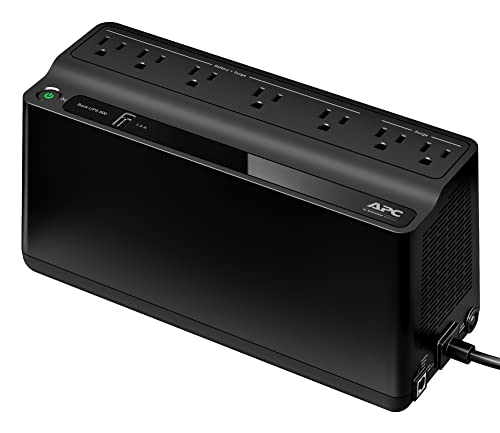
APC’s BE600M1 is the standby counterpart to the Pro above: 600VA and 330W across seven outlets, with a USB charging port, in a compact case meant for desks. It suits the classic small setup of a modem, a router and a backup drive that only needs a graceful few minutes when the lights go out. Because the Back-UPS line carries no voltage regulation, this model belongs on clean power; put it on a sagging circuit and you are asking a transfer switch to do a regulator’s job every single week.
Specs
- Brand: APC, per the product title
- Model: BE600M1, per the product title
- Type: Standby (the Back-UPS line has no AVR), per the product line and title
- Capacity: 600VA / 330W, per the product title
- Outlets: 7 outlets (NEMA 5-15R), per the product title
- USB: USB charging port, per the product title
Best for: A modem, router and small backup drive that need outage cover on otherwise clean power.
Watch out for: The 330W ceiling is firm, so a desktop tower plus monitor can push past it even though the plugs fit.
ASIN: B01FWAZEIU
Which One Fits Your Situation
A NAS that must shut down without corrupting the array
Pick a line-interactive model, the CyberPower CP1500AVRLCD3 or the APC BX1500M, and connect the data cable so the NAS can shut itself down during a long outage. Regulation handles the weekly sags, and the larger battery gives the array time to close files in order instead of dropping mid-write. That orderly close is the whole point.
A street where the lights dip every time large appliances start
That pattern is exactly what AVR exists for, so line-interactive is the answer again. A standby unit would switch to battery at every deep sag and wear its battery out early, while the CyberPower and APC Pro models above correct the dip from the transformer and save the battery for real outages.
Clean suburban power and only the router needs cover
Save the larger units for someone else. The CyberPower ST625U or APC BE600M1 will carry a modem, router and one backup drive through short outages, which is all a stable street usually asks. Spend the effort instead on placing the unit where its battery stays cool, dry and easy to reach.
A small apartment desk with a laptop dock and one drive
A standby model fits here too, since the laptop carries its own battery and only the drive truly needs protection. The BE600M1 keeps the footprint small, and its USB charging port covers a phone. Move up to line-interactive only if the building power visibly flickers, or the drive holds the only copy of important files.
Common Mistakes
- Buying by the VA number alone and discovering the watt rating is lower than the load.
- Choosing standby for a street with weekly brownouts, then replacing worn batteries every year.
- Plugging a laser printer or space heater into battery outlets and tripping the unit mid-outage.
- Skipping the data cable, so the NAS never gets the signal to shut down cleanly.
- Hiding the UPS in a closed cabinet where battery heat builds up and shortens its life.
Frequently Asked Questions
What is the core difference between line-interactive and standby?
A standby UPS switches to battery only when power fails or swings far out of range. A line-interactive UPS also regulates voltage, correcting sags and swells through a transformer without using the battery. On clean power they behave alike; on rough power the line-interactive unit protects far more often.
Does a standby UPS protect a NAS against brownouts?
Only partly. A standby unit ignores a sag until voltage falls below its transfer threshold, so a shallow brownout can still reboot the NAS or drop a drive. If brownouts are a known pattern on your street, that gap is the reason to choose a line-interactive model instead.
Which type is better for a home server that runs all day?
Line-interactive, in most homes. A server that never sleeps meets every flicker the street produces, and regulation plus a data connection for orderly shutdown covers both the short dips and the long outages. The CyberPower CP1500AVRLCD3 and APC BX1500M above are sized for exactly that duty.
Can either type run my whole desk through a long outage?
Neither is built for that. Home UPS units of both types deliver minutes at working loads, enough to save files and shut down in order. If you need hours of working time, the honest answer is a much larger battery system, with the UPS kept as the bridge that protects the first few minutes.
More from Amazon
Programs that pair well with the guide above. Offers and eligibility are set by Amazon and may change.
A free business account with business pricing and bulk-buying tools for work, shop or home office.
Create a business accountFree shipping on eligible items, Prime Video and more. Eligible new members can start with a free trial.
Start a Prime free trialAudiobooks and podcasts to listen to on the go. Eligible new members can start with a free trial.
Try Audible freeAd-free music streaming. Eligible new subscribers can start with a free trial.
Try Music Unlimited freeAs an Amazon Associate we earn from qualifying purchases.


Write Your Review
No reviews yet. Be the first to share your experience!