

Key takeaways
- Find the best 40gbe network adapters for servers and NAS rigs, covering dual-port QSFP+, single-port, low-profile, RDMA and storage offload picks.
A 40GbE network adapter gives a server or NAS a single link with four times the bandwidth of a 10GbE port, carried over one QSFP+ or QSFP28 cage. For a storage head unit feeding several compute nodes, a backup target ingesting many clients at once, or a virtualization host whose virtual machines share one uplink, that headroom removes the network as the bottleneck. Every card here uses a PCIe 3.0 x8 host interface and takes direct-attach copper or fiber modules bought separately.
The honest complication is the state of this market on Amazon. The 40GbE generation is mature and largely end-of-life at the controller makers, so listings mix genuine maker cards, third-party boards built on genuine controllers, and much refurbished and pulled enterprise stock. Every class below has a live listing for its reference model, though stock for the older enterprise parts often comes through resellers rather than the makers themselves, so the seller, condition and included bracket deserve a close look before ordering.
As an Amazon Associate, we earn from qualifying purchases.
Quick answer
For most server and NAS builds, the Mellanox MCX314A-BCCT is the top pick: a genuine dual-port QSFP+ card on the ConnectX-3 controller with PCIe 3.0 x8 and mature drivers. Choose the GLOTRENDS ConnectX-3 VPI card for hardware RDMA, the Vogzone XL710-QDA2 for storage offload, and read the low-profile section carefully before buying for a 2U chassis.
Mellanox MCX314A-BCCT ConnectX-3 EN Dual-Port Adapter

The top pick is the genuine Mellanox card that anchors most second-hand 40GbE builds. The listing describes the MCX314A-BCCT as a ConnectX-3 EN network adapter on PCI Express 3.0 x8, with two QSFP+ ports running 40GbE Ethernet; the part also carries the 56 gigabit Mellanox proprietary rate used between Mellanox endpoints. The controller brings hardware stateless offload, SR-IOV virtualization, traffic steering across cores and RDMA over Converged Ethernet, and the driver story is the strongest argument for the card: Linux carries an in-kernel driver for this family, and Windows and VMware support comes through the established Mellanox software stacks.
Two ports matter more than they first appear to. They allow a redundant pair of links to two switches, a bonded link for double bandwidth to one switch, or storage traffic on one port and client traffic on the other, all from a single slot. For a NAS or backup target that must stay reachable while a switch reboots, that redundancy is the practical reason to pick this class over a single-port card.
The trade-offs are generational. This controller family is end-of-life, so support means community knowledge and archived driver packages rather than new releases; confirm the driver package for your exact operating system version before ordering. Amazon stock for this part is heavily weighted toward pulled and refurbished units, so read the condition line and seller details, and plan a firmware check against the card’s PSID once it arrives. No cable or optical module is included, and bracket fit for short chassis should be confirmed on the listing.
Mellanox MCX4131A-GCAT ConnectX-4 Lx EN Single-Port Adapter

One class up in controller generations sits the single-port pick. The MCX4131A-GCAT is a ConnectX-4 Lx EN adapter with one QSFP28 port documented for 1, 10, 25, 40 and 50 gigabit Ethernet rates, on a PCIe 3.0 x8 host interface. For a 40GbE buyer, the relevant point is that the port runs a full 40GbE link while the card belongs to the newer mlx5 driver family, the actively maintained Mellanox software line. The maker’s documentation gives the board dimensions as 2.71 by 5.6 inches, a low-profile board supplied with the tall bracket fitted and a short bracket in the box.
A single port suits a node that needs one fast uplink and nothing more: a compute node in a cluster, a workstation pulling from a NAS, or a backup client. Giving up the second port removes failover, so this card belongs on machines whose downtime during a switch or cable fault is acceptable. RoCE RDMA support is present in this controller family for buyers who later want low-latency storage traffic over the same link.
Honest limitations: NVIDIA now lists the ConnectX-4 Lx line as end-of-life, so this is still a previous-generation purchase, simply a younger one than the ConnectX-3 cards. The QSFP28 cage accepts 40G optics and direct-attach cables, but module compatibility should be confirmed against both this card and the switch at the other end, and nothing is bundled.
Chelsio T580-LP-CR Dual-Port Low-Profile Adapter
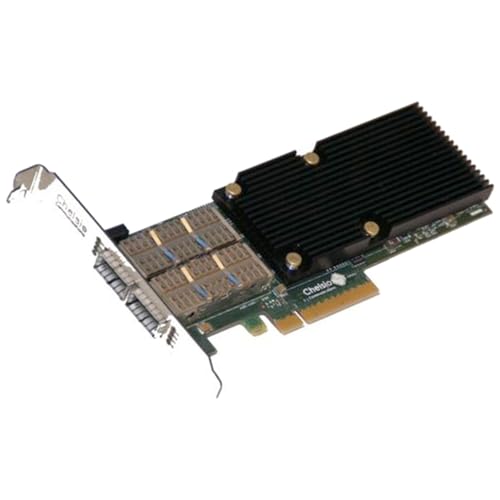
The low-profile class is where this guide has to be blunt. The reference model is Chelsio’s T580-LP-CR, a dual-port 40GbE Unified Wire adapter designed from the outset as a low-profile card: Chelsio’s product brief gives board dimensions of 6.6 by 2.71 inches on a PCI Express Gen3 x8 interface, with two QSFP+ connectors. The T5 controller offloads TCP, UDP, iSCSI, FCoE and iWARP RDMA processing in hardware, adds SR-IOV and Data Center Bridging, and is aimed squarely at 2U servers and dense chassis where a tall bracket card cannot go. On paper it is also the most offload-heavy card in this guide.
On Amazon this card is sold through enterprise resellers rather than by Chelsio directly, and stock levels move with pulled and surplus inventory, so listings can appear and disappear between searches. Buyers set on this class should confirm the seller, the stated condition and the included low-profile bracket on the listing before ordering, and plan a firmware check once the card arrives.
Two genuine trade-offs apply whenever the card is bought. Chelsio’s own documentation states that only Chelsio-supplied optical modules may be used, which narrows module choice compared with the open cages on the Mellanox and Intel cards. The Unified Wire driver stack is also a separate ecosystem from the Mellanox and Intel tooling used elsewhere in this guide.
GLOTRENDS 2-Port 40Gb QSFP+ NIC With ConnectX-3 VPI

The RDMA pick is a third-party board with an unusually explicit listing. The GLOTRENDS card is built on the Mellanox ConnectX-3 VPI controller, part MCX354A-FCBT, with two QSFP+ ports that each run either 56 gigabit FDR InfiniBand or 40GbE Ethernet, selected per port, on a PCIe 3.0 x8 interface. The listing states hardware RDMA in plain terms: native InfiniBand RDMA plus RoCE over Ethernet, moving data between nodes without CPU copies, alongside SR-IOV, quality of service controls, congestion control and PXE and UEFI boot. Both low-profile and full-height brackets are listed as included.
That dual-fabric ability is the reason to buy this card over the top pick. A small cluster can run Ethernet storage traffic today and InfiniBand messaging later, or split the ports across one fabric each, without changing hardware. For Ceph, Lustre or MPI-style workloads in a small data room, hardware RDMA at this controller generation is the cheapest entry point that still behaves like enterprise fabric gear.
The caveats match the hardware’s age and origin. GLOTRENDS is the board seller, not the controller maker, so firmware and drivers come from the Mellanox and NVIDIA archives for the ConnectX-3 family, and support expectations should be set accordingly. On the Ethernet side, this generation’s RoCE is the first-generation flavor rather than the later routable version, which matters for larger routed fabrics. Each port must also be set to the intended protocol mode during setup; a VPI card left in the wrong mode is a common cause of a link that refuses to appear.
Vogzone XL710-QDA2 Dual-Port Adapter With Storage Offload

The converged pick is a third-party board on Intel’s XL710 controller. The listing describes the Vogzone card as a 40GbE adapter with an original Intel XL710-BM2 controller, two QSFP+ ports covering 1, 10 and 40 gigabit rates, and a PCIe 3.0 x8 interface that also fits x16 slots. Its stated feature list is the storage story: on-chip quality of service and traffic management, Flexible Port Partitioning, VMDq, PCI-SIG SR-IOV, and the storage protocols iSCSI, FCoE and NFS, with jumbo frames, PXE boot, DPDK and Data Center Bridging also listed. A low-profile bracket is included, and the listing states plainly that the QSFP module is not included.
For a storage server that serves block and file protocols over the same wire, that combination is the appeal: one adapter whose partitioning and virtualization features are documented in depth by Intel, with storage offload named on the listing rather than implied. It is also the natural choice for shops already standardized on Intel network tooling.
The honest reservations: this is a board built by a third-party seller around the Intel controller, not an Intel retail adapter, so firmware sourcing and warranty run through the seller. The XL710 generation is also known for selective behavior with third-party optical modules, so module and DAC choices should be confirmed against the listing and the switch before money is spent.
How to choose
Pick the controller generation first, because it decides your driver future. ConnectX-3 cards are the budget entry with archived software stacks; ConnectX-4 Lx moves to the maintained mlx5 family; Intel XL710 brings Intel’s partitioning and storage feature set. Then decide port count: dual ports for bonding or failover, a single port only where one uplink is genuinely enough. Match the cage to your cabling next: the module or DAC must suit the card, the switch and the distance, and none of these cards bundle one.
Check the physical fit before anything else is finalized: a free PCIe 3.0 x8 or wider slot, and the bracket height your chassis accepts, which is the entire point of the low-profile class. If RDMA is on the roadmap, decide which flavor you need, since native InfiniBand, first-generation RoCE, later RoCE and iWARP are not interchangeable, and RoCE fabrics expect switch features such as priority flow control. Finally, treat condition as a specification: on a market this full of pulled stock, the seller, the stated condition and a planned firmware check on arrival are part of the purchase.
Who should skip
Skip 40GbE entirely if your switch has no 40G ports and no upgrade is planned; a good 10GbE or 25GbE adapter will serve you better today. Skip these end-of-life controller generations if you need current vendor support contracts, guaranteed new stock, or drivers certified for the newest hypervisor releases. Skip the RDMA card if your workload is ordinary file and block traffic, since RDMA adds fabric tuning work that only latency-sensitive clusters repay.
Frequently Asked Questions
Do any of these adapters include a cable or optical module?
No. The Vogzone listing states explicitly that the QSFP module is not included, and the Mellanox and GLOTRENDS listings are for the card and brackets. Budget for a direct-attach copper cable for short in-rack runs or a matched pair of QSFP optics and fiber for longer ones, and confirm module compatibility at both ends of the link.
Can a QSFP28 port and a QSFP+ port link at 40GbE?
In most server and switch gear, yes: a QSFP28 cage accepts QSFP+ modules and DACs and negotiates the shared 40GbE rate, which is how the ConnectX-4 Lx pick here talks to older 40G switches. Compatibility is set by each device’s firmware and module checks, so confirm both ends accept the chosen cable or optic before ordering.
Is a refurbished or pulled enterprise card a reasonable buy?
It is the normal way this market works, and the cards are built for long service lives, but buy with your eyes open. Read the condition and seller details on the listing, prefer listings that name the exact part number, and on arrival verify the card’s identity and firmware, including the PSID on Mellanox hardware, before production use.
Which driver stack does each family use?
Linux carries in-kernel drivers for both Mellanox generations, with the ConnectX-4 Lx on the newer mlx5 family and ConnectX-3 on the earlier mlx4 family; Windows uses the Mellanox WinOF packages matched to the generation. Intel XL710 cards use Intel’s standard 700-series drivers, and Chelsio cards use Chelsio’s Unified Wire stack.
Final verdict
For a straightforward 40GbE upgrade, buy the genuine Mellanox MCX314A-BCCT: two QSFP+ ports, a proven controller and the deepest pool of stock and community knowledge. Step to the ConnectX-4 Lx single-port card for a newer driver family, to the GLOTRENDS VPI card when hardware RDMA or a future InfiniBand fabric is the goal, and to the Vogzone XL710-QDA2 when storage protocols share the wire. Choose the low-profile Chelsio when a 2U or dense chassis rules out a tall-bracket card, and check the condition of every unit in this end-of-life market before it enters a production rack.
Product and ASIN Reference
| Product | ASIN |
|---|---|
| Mellanox MCX314A-BCCT ConnectX-3 EN Dual-Port Adapter | B00MJEDH1Y |
| Mellanox MCX4131A-GCAT ConnectX-4 Lx EN Single-Port Adapter | B01A0TDR2I |
| Chelsio T580-LP-CR Dual-Port Low-Profile Adapter | B00FAU8A2U |
| GLOTRENDS 2-Port 40Gb QSFP+ NIC With ConnectX-3 VPI | B0DS144C63 |
| Vogzone XL710-QDA2 Dual-Port Adapter With Storage Offload | B08RDGFH33 |
More from Amazon
Programs that pair well with the guide above. Offers and eligibility are set by Amazon and may change.
A free business account with business pricing and bulk-buying tools for work, shop or home office.
Create a business accountFree shipping on eligible items, Prime Video and more. Eligible new members can start with a free trial.
Start a Prime free trialAudiobooks and podcasts to listen to on the go. Eligible new members can start with a free trial.
Try Audible freeAd-free music streaming. Eligible new subscribers can start with a free trial.
Try Music Unlimited freeAs an Amazon Associate we earn from qualifying purchases.
Write Your Review
No reviews yet. Be the first to share your experience!