

Key takeaways
- Compare the best weather stations for tracking temperature, humidity, wind and rain around server and drive storage spaces, with console and app picks.
Heat and humidity are slow enemies of stored data. A NAS box in a hot closet, backup drives in a damp basement or an archive shelf under a roof that leaks in storms all age faster than they should, and the first sign of trouble is often a failed drive. A home weather station will not protect a drive by itself, but it gives you address-level readings for the conditions that matter: outdoor temperature and humidity swings that drive indoor climate, rainfall totals that flag drainage problems, and wind and pressure trends that warn of storms before they arrive. The five stations below cover the main shapes of the category, from full wireless arrays with app sharing to a simple offline display.
As an Amazon Associate, we earn from qualifying purchases.
Quick answer
Start with the Ambient Weather WS-2902 for a full sensor array, a color console and Wi-Fi uploads. Choose the AcuRite Iris 01512M for wind and rain data with no internet connection, the Sainlogic WS3500 for the largest display, the Ecowitt Wittboy GW2001 for a no-moving-parts sensor, and the La Crosse 308-1414B for temperature and humidity only.
Ambient Weather WS-2902 WiFi Smart Weather Station
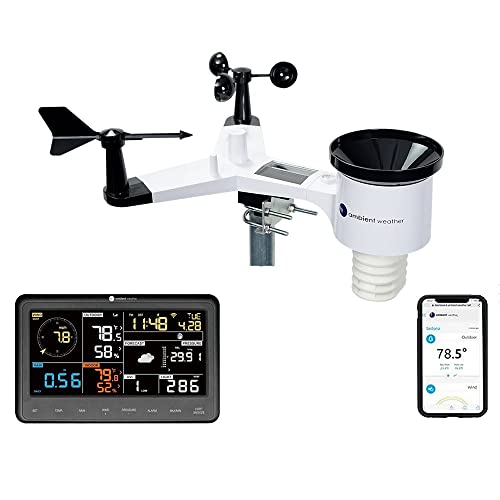
The WS-2902 is built around the Osprey sensor array, which combines wind cups, a wind vane, a rain collector, temperature and humidity sensors, and a solar panel with battery backup in a single outdoor unit. It reports wind speed and direction, rainfall, outdoor temperature and humidity, UV and solar radiation, sending readings to a color console indoors while also uploading over Wi-Fi to Weather Underground, AmbientWeather.net and other networks, so conditions at home can be checked from a phone anywhere.
For storage monitoring, that upload history is the useful part: a week of heat and humidity data shows whether a garage or outbuilding stays in a safe band for stored drives or swings wildly with the weather. Setup follows the standard pattern for this class. Mount the array on a pole or rail with a clear view of the sky, keep it level so the rain gauge reads honestly, and place the console where it will actually be glanced at. The console shows current conditions plus daily highs and lows. Because the array is solar-assisted, battery changes are infrequent. It is the most complete package in this group.
AcuRite Iris (5-in-1) Weather Station with Digital Display (01512M)
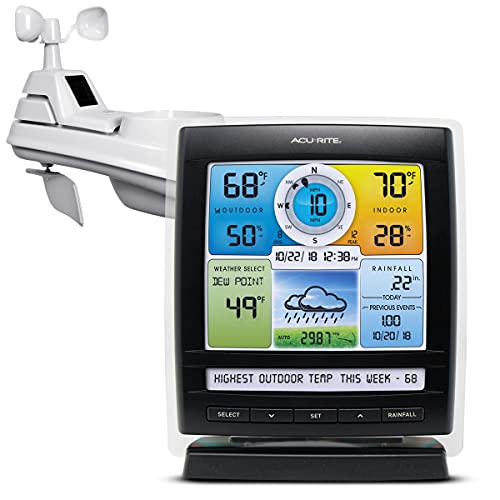
The AcuRite Iris 01512M takes the opposite approach to connectivity: there is no Wi-Fi and no app, and that is exactly why some buyers prefer it. The 5-in-1 outdoor sensor measures temperature, humidity, wind speed, wind direction and rainfall, and sends everything wirelessly to a digital display that shows current conditions, a forecast based on barometric pressure, the time, and indoor temperature and humidity as well. Nothing leaves the house, nothing needs an account, and no cloud service is involved at any point.
That offline design suits a storage room or workshop where the network is an afterthought. The display is made to sit on a counter or hang on a wall, and it keeps daily records so overnight rainfall is visible in the morning. The self-emptying rain gauge and the wind instruments cover the measurements most home users actually check. The outdoor sensor runs on batteries and should be mounted five to ten feet up with open sky above it for honest rain and wind numbers. If the goal is a station that works the day it is installed, keeps working when the internet goes down, and never asks for a login, this is the straightforward pick.
Sainlogic WiFi Weather Station with Rain Gauge and Wind Gauge (WS3500)

The Sainlogic WS3500 pairs a full outdoor sensor array with one of the larger consoles in its class, an 8.3 inch display that lays out temperature, humidity, wind, rainfall, pressure and forecast information in a single glanceable grid. The outdoor unit covers wind speed and direction, rain, temperature and humidity, and the system connects over Wi-Fi so readings upload to Weather Underground and Weathercloud, with live data viewable in an app away from home.
That big screen is the main reason to choose it over the Ambient Weather model above: in a hallway or office it works almost like a wall-mounted weather board, readable from across the room without squinting at small digits. The console also keeps records of highs, lows and rainfall totals, the numbers that matter when judging whether a basement storage area stayed dry through a wet month. Installation follows the same rules as any array station: a level mount, open sky for the rain collector, and distance from heat sources such as dryer vents that would skew temperature readings. For a household that will actually look at the display every morning and still wants app access and network sharing on top, the WS3500 splits the difference neatly.
Ecowitt Wittboy Weather Station GW2001 with WS90 7-in-1 Sensor

The Wittboy takes a different engineering path: its WS90 outdoor sensor has no moving parts at all. Wind is measured ultrasonically instead of with spinning cups, and rain is measured by a haptic sensor that detects impacts on its surface instead of a tipping bucket. That removes the two most common wear points on a home station, the bearings in the wind cups and the mechanism in the rain gauge, which makes it appealing for rooftops and other spots where climbing up for maintenance is a chore.
The kit pairs the sensor with a Wi-Fi gateway hub rather than a traditional console, so readings live in the Ecowitt app and on Ecowitt.net, with uploads to Weather Underground and other services supported. The sensor also reports light, UV, temperature and humidity. The gateway can receive a wide range of extra Ecowitt sensors later, from soil moisture to additional indoor room sensors, which makes this the most expandable system here; extra room sensors are a natural fit for watching a server closet or drive archive directly. The trade-off is the lack of a dedicated display in the box, since conditions are checked on a phone or tablet. For a tech-comfortable household that values low maintenance and future expansion, it is the smartest route in this group.
La Crosse Technology Advanced Weather Station with Full-Color LCD and Atomic Time (308-1414B)

Not every monitoring job needs wind and rain data. The La Crosse 308-1414B is a simple indoor-outdoor station: a wireless outdoor sensor reports temperature and humidity to a full-color LCD that also shows indoor conditions, animated forecast icons based on pressure trends, temperature alerts, and an atomic clock that sets itself from the national time signal. It answers the two questions that matter most for a storage corner each morning: how hot or damp is it out there, and is the trend getting worse.
The temperature alerts are the feature that earns it a place here. Set a high-temperature threshold and the display flags when the outdoor sensor crosses it, a basic early warning for heat building around a home office or media shelf. There is no app, no Wi-Fi and no sensor array to mount on the roof; the small outdoor sensor tucks under an eave or on a porch post, and the transmission range covers a typical house and yard. Adjustable brightness keeps the color display comfortable at night. The honest limits are clear: with no wind or rain instruments it cannot report rainfall, and the forecast icons are trend indicators rather than predictions. As a low-effort way to keep live temperature and humidity on a clear screen, it does its narrower job well.
How to choose
Start with the measurements that will actually be used. Storm awareness and drainage checks call for rain and wind, which means a full outdoor array like the WS-2902, the Iris or the WS3500. If temperature and humidity are the only concerns, a simple station like the La Crosse covers them with far less setup. Next, decide how the data will be read: a color console on the counter, an app on a phone, or both. Wi-Fi models upload to networks such as Weather Underground, which also builds a season-long history of conditions around the house. Mounting matters more than most specifications. Every outdoor sensor needs open sky for rain, clearance from walls and vents for honest temperature, and a level mount. Finally, think about power and upkeep: solar-assisted arrays and no-moving-parts sensors reduce battery changes and maintenance, while basic sensors are inexpensive to replace if a storm damages them. Buyers who need alerts inside a specific room should look at expandable systems that accept extra indoor sensors.
Who should skip
Skip this category if a phone forecast already answers every question; a station only pays off when conditions at the exact address matter. Skip home stations if research-grade accuracy is needed for agriculture, aviation or storm reporting, where calibrated professional instruments are the right tool. Renters who cannot mount anything outdoors, even on a balcony rail, will get limited value from an array station and should consider the simple indoor-outdoor models instead. Anyone who needs a guaranteed alarm the moment a server room overheats should look at dedicated monitoring with push alerts instead. And if home Wi-Fi is unreliable, a console-based station that works fully offline is a better fit than a gateway-only system.
Frequently asked questions
Do home weather stations need Wi-Fi?
No. Wi-Fi only matters for app access away from home and uploads to weather networks. Stations like the AcuRite Iris and the La Crosse work entirely offline, sending sensor data straight to their own displays. Wi-Fi models also keep working locally if the internet drops; they simply pause uploading until the connection returns, so no readings are lost during an outage.
Where should the outdoor sensor be mounted?
Mount array sensors on a pole or rail roughly five to ten feet above open ground, level, with clear sky above for the rain gauge and no walls, roofs or vents nearby to distort wind or temperature readings. Simple temperature and humidity sensors do best under an eave on the shaded side of the house, out of direct sun and rain, where they track the air that actually surrounds the building.
How accurate are home weather stations?
Temperature and humidity readings from the picks here are generally within a degree or two of reference instruments when the sensor is sited properly, which is plenty for frost warnings, storage checks and daily planning. Wind and rain numbers depend heavily on mounting; a poorly placed array will under-report both regardless of the hardware, so siting deserves as much attention as the purchase itself.
Do weather stations need much maintenance?
Very little. Plan on fresh batteries for basic sensors once or twice a year, an occasional rinse of the rain collector to clear leaves and insects, and a quick check that the array is still level after big storms. Solar-assisted and no-moving-parts sensors cut that upkeep further, which is why they suit roof mounts and other spots that are awkward to reach.
Final verdict
The Ambient Weather WS-2902 is the easiest general recommendation: a complete array, a proper console and painless network sharing in one box. The AcuRite Iris 01512M is the better buy for wind and rain with zero internet involvement, the Sainlogic WS3500 wins on display size, and the Ecowitt Wittboy GW2001 is the low-maintenance, expandable choice for app-first households. The La Crosse 308-1414B covers the simplest job, live temperature and humidity on a clear screen with threshold alerts. Any of them turns guesswork about the conditions around stored drives into recorded numbers.
Product and ASIN Reference
| Product | ASIN |
|---|---|
| Ambient Weather WS-2902 WiFi Smart Weather Station | B01N5TEHLI |
| AcuRite Iris (5-in-1) Weather Station with Digital Display (01512M) | B00N1XCA9M |
| Sainlogic WiFi Weather Station with Rain Gauge and Wind Gauge (WS3500) | B08G1GR9NJ |
| Ecowitt Wittboy Weather Station GW2001 with WS90 7-in-1 Sensor | B09TZZTYPK |
| La Crosse Technology Advanced Weather Station with Full-Color LCD and Atomic Time (308-1414B) | B00MUOIQ8W |
More from Amazon
Programs that pair well with the guide above. Offers and eligibility are set by Amazon and may change.
A free business account with business pricing and bulk-buying tools for work, shop or home office.
Create a business accountFree shipping on eligible items, Prime Video and more. Eligible new members can start with a free trial.
Start a Prime free trialAudiobooks and podcasts to listen to on the go. Eligible new members can start with a free trial.
Try Audible freeAd-free music streaming. Eligible new subscribers can start with a free trial.
Try Music Unlimited freeAs an Amazon Associate we earn from qualifying purchases.


Write Your Review
No reviews yet. Be the first to share your experience!