

Key takeaways
- Five verified moisture meters, pin and pinless, for tracing leak spread and checking walls, floors and lumber before drives go back into storage.
Water is the quiet enemy of stored data. A slow pipe drip or a roof leak above a rack room can soak drywall, subfloor and wooden shelving for weeks before anyone notices, and drives put back into a damp room corrode long after the puddle is gone. A leak detector tells you water has arrived; a moisture meter tells you how far it spread and whether the room is truly dry again. This guide compares five verified meters, pin and pinless, for checking the walls, floors and lumber around NAS boxes, backup drives and media archives.
As an Amazon Associate, we earn from qualifying purchases.
Quick answer
For scanning walls and floors around a rack or media shelf without leaving pinholes, the Klein Tools ET140 pinless meter is the first reach. For a direct percent reading in studs, subfloor and shelving, the General Tools MMD4E pin meter is the straightforward pick. Lumber-focused buyers who need field calibration should look at the Wagner Orion 920.
Klein Tools ET140 Pinless Moisture Meter

The ET140 is the sweeping tool in this guide. Its pinless electromagnetic sensor detects relative moisture up to 3/4 inch (19 mm) below the surface, so a whole wall behind a rack or a run of flooring around a media cabinet can be mapped in minutes without a single pinhole. A mode button switches between drywall, masonry, hardwood and softwood, and readings show on a bright reverse-contrast display backed by an LED bar graph that makes wet zones easy to spot at a glance.
Because the ET140 reports relative moisture rather than an absolute percent, the working method is comparison: take a baseline reading on a patch of the same material that is known to be dry, then scan the suspect area and log where the numbers climb. That is exactly the workflow a leak check needs, since the goal is finding the boundary of the wet zone, not certifying a lumber grade. The meter runs on one 9V battery, which is included, and weighs 7 ounces, light enough to live in the same drawer as the spare cables. For storage rooms with finished walls you do not want to perforate, this is the meter to reach for first.
General Tools MMD4E Digital Moisture Meter
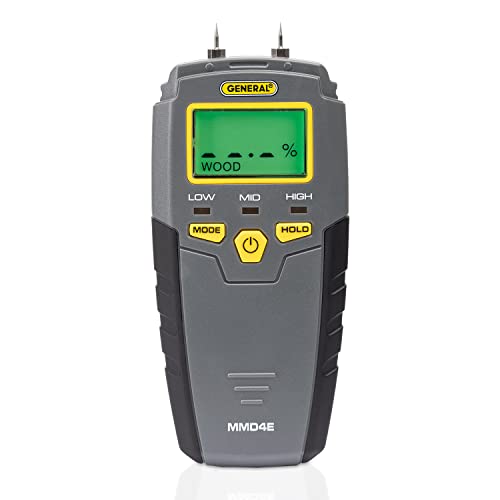
Where the ET140 sweeps, the MMD4E confirms. Its two stainless steel pins push into the material and return an actual moisture percent: 5 to 50 percent for wood and 1.5 to 33 percent for building materials such as concrete and drywall, per the listing. That makes it the right second step after a pinless scan, settling whether a stud, a subfloor edge or a shelf board is genuinely wet at the point that matters.
The listing spells out a practical kit: a backlit LCD, audible and visual low, medium and high moisture alerts, a reading hold button, and replaceable 8 mm pins, with spare pins and a 9V battery in the box. The protective cap doubles as a calibration checker, a small but real assurance that the meter is reading honestly before you trust a dry verdict. Auto power off protects the battery between checks, and General Tools backs the meter with a 1-year warranty. At 5.6 ounces it is the lightest pick here. The trade-off is the one every pin meter carries: it leaves two small holes at each test point, so it belongs on framing, subfloor and utility shelving rather than finished faces.
Tavool Wood Moisture Meter (MT270)

The Tavool MT270 is a pin meter built around wood, which earns it a place in storage work more often than its name suggests. Wooden shelving, shipping crates, pallets and cabinet carcasses are what backup media and spare drives actually sit on, and a board that reads wet is a board that keeps the air around your gear damp. The MT270 sorts wood into eight calibration groups, from teak and walnut through pine and birch, so the reading reflects the species instead of a generic average.
The listing describes two measurement modes, one for wood and one for building material, with wood results banded as low from 5 to 12 percent, medium from 12 to 17 percent and high from 17 to 60 percent, shown on a backlit LED screen. Those bands translate well to storage decisions: a shelf board sitting in the high band comes out of the room, while one in the low band can stay. Pin readings are point readings, so dense hardwoods need firm, even pressure to seat the pins, and finished surfaces will show the marks. For buyers whose storage is mostly timber and board rather than drywall, the species groups are the reason to pick this one.
Wagner Meters Orion 920 Pinless Wood Moisture Meter

The Orion 920 is the precision instrument of the five, aimed at lumber rather than walls. Its pinless sensor reads from the surface down to 1/4 inch (6.4 mm), a shallow depth Wagner intends for boards and finished stock, and every meter ships paired with an On-Demand Calibrator that recalibrates it in the field in about 30 seconds. There is no factory return for calibration, and a NIST-traceable calibrator version exists for buyers who need the paperwork.
Species settings are selected with simple arrow buttons and cover softwoods and hardwoods broadly; the meter can also be user-configured for plywood, OSB and MDF, which covers most shelving and crate materials found in a storage room. Wagner states its sensing is virtually unaffected by the temperature of the wood or the room, removing a correction pin meters ask for. A relative moisture mode supports comparison work, and a rubber boot protects the housing. Two honest limits from the listing: there is no backlit screen, so dim closets need a work light, and at 1.52 pounds with a 9V battery included, it is the heaviest and most specialised pick here. Choose it when lumber readings themselves are the record that matters.
RDINSCOS MT19 Wood Moisture Meter (MT19B)

The MT19 is the budget spot-checker of the group, a compact pin meter that covers the basics without ceremony. Its pins read up to 12 mm into the material, and a switch selects hardwood or softwood. The listing frames its output as relative moisture content, which suits go or no-go checks: is this shelf board dry enough to put the drive cases back, or does it need another week with the dehumidifier running.
Practical touches from the listing include a hold function for readings taken at awkward angles, a backlit LCD, and green, yellow and red LED indicators for low, medium and high moisture, with auto shutoff to save the three included AAA batteries. A spare pin and a small spanner come in the box along with a storage bag, which matters because bent pins are the usual end of a cheap meter. The meter weighs 7.4 ounces and measures 4.72 by 2.36 by 1.18 inches. The brand’s own guidance on the listing is candid that very dry wood can read at or near zero and that readings are comparative rather than laboratory grade, so treat it as a screening tool and confirm borderline results with a percent-reading meter.
How to choose
Start with the sensing method. Pinless meters scan a volume of material and report relative moisture, which is ideal for mapping how far water spread through a wall or floor without damaging the surface. Pin meters measure the material between two probes and, on models like the MMD4E, report an actual percent, which is better for a final dry or wet decision at one spot. Many storage rooms end up wanting both: scan first, then confirm.
Depth is the second filter. The ET140 sees up to 3/4 inch down, the Orion 920 a shallower 1/4 inch aimed at boards, and pin meters read only as deep as the pins reach, 12 mm on the MT19. Match the depth to the material: drywall over studs wants scan depth, while a shelf board wants a reading in the board itself. Third, check material support. Modes for drywall and masonry matter for room checks; species groups and settings matter when the load is lumber, crates and shelving. Finally, weigh calibration and alerts: a cap checker or field calibrator keeps readings trustworthy over years, and audible alerts help when the meter is pressed into a dark corner you cannot see.
On safety: a CPSC-oriented search surfaced no recall covering moisture meters as a class or any of the five models in this guide. That is a plain statement of what the record shows, not a guarantee; before a bulk purchase, confirm the exact brand and model against the CPSC database.
Who should skip
Skip this category if all you need is a yes or no alarm when water appears; a dedicated leak detector with a remote sensor does that job better and watches while you are away. Skip it during active flooding, where the priority is stopping the source and extracting water, not measuring what is already soaked. Skip these handheld meters if you need in-slab relative humidity testing for a flooring warranty, which calls for probe-based systems of a different class. And if your drives live in a sealed, rated enclosure in a room with no plumbing above it and no history of water entry, a meter is a nice-to-have rather than a necessity.
FAQ
Pin or pinless: which suits a storage room check?
Pinless suits the first pass. It maps a whole wall or floor quickly, leaves no marks, and shows where readings climb compared with a known dry patch. Pin meters suit the second pass, confirming a percent at the exact stud, board or subfloor point in question. Rooms that protect valuable backups justify owning one of each style.
What reading means a wall is too wet for stored drives?
There is no single number that fits every material and scale, which is why comparison matters. Read a patch of the same wall that is certainly dry, then treat any sustained jump well above that baseline, or a result in the meter’s high band, as a stop sign. Keep drives out until readings fall back near the dry baseline.
Can a moisture meter find the source of a leak?
Not directly. A meter maps where material is wet, and the shape of that map often points uphill toward the entry point, but the source itself, a cracked fitting, failed flashing or a sweating pipe, still has to be found by opening up and looking. The meter’s job is to size the problem and later to prove the drying worked.
Do these meters read through tile, metal or paint?
Paint is usually no obstacle for either style. Metal is: pinless sensors are thrown off by metal mesh, foil backing and steel shelving near the scan area, and pins cannot be driven into tile or metal at all. For tiled or foil-backed surfaces, measure from an exposed edge or the reverse side of the partition where possible.
Final verdict
For most storage rooms, the Klein Tools ET140 is the meter that earns its drawer space: it finds the edges of a wet zone fast and leaves finished walls unmarked. Pair it with the General Tools MMD4E when a firm percent is needed before gear goes back on the shelf. The Tavool MT270 serves lumber-heavy storage, the Wagner Orion 920 serves buyers who need calibration they can document, and the RDINSCOS MT19 covers routine spot checks at the lowest commitment. Dry first, verify second, and only then trust the room again.
Product and ASIN Reference
| Product | ASIN |
|---|---|
| Klein Tools ET140 Pinless Moisture Meter | B07SZX8QXH |
| General Tools MMD4E Digital Moisture Meter | B00275F5O2 |
| Tavool Wood Moisture Meter (MT270) | B07VHJTHBP |
| Wagner Meters Orion 920 Pinless Wood Moisture Meter | B07JZGGR3Q |
| RDINSCOS MT19 Wood Moisture Meter (MT19B) | B0967ZP5B1 |
More from Amazon
Programs that pair well with the guide above. Offers and eligibility are set by Amazon and may change.
A free business account with business pricing and bulk-buying tools for work, shop or home office.
Create a business accountFree shipping on eligible items, Prime Video and more. Eligible new members can start with a free trial.
Start a Prime free trialAudiobooks and podcasts to listen to on the go. Eligible new members can start with a free trial.
Try Audible freeAd-free music streaming. Eligible new subscribers can start with a free trial.
Try Music Unlimited freeAs an Amazon Associate we earn from qualifying purchases.


Write Your Review
No reviews yet. Be the first to share your experience!