

Key takeaways
- Five electronic dry cabinets compared on capacity, humidity range, power and locks, to keep cameras, lenses, drives and valuables safe from damp air.
Stored gear fails quietly. A lens left in a humid room grows fungus on its internal elements, a camera body’s contacts corrode, and hard drives, memory cards and optical media kept for the long term all degrade faster in damp air. An electronic dry cabinet is the dehumidifier built for this job: a sealed, gasket-doored cabinet whose thermoelectric module holds the interior at a set humidity level around the clock, with no water tank to empty. The five cabinets below run from a 30-liter desktop box to a 125-liter studio cabinet, and each one was verified as a current Amazon.com listing before it earned a place here.
As an Amazon Associate, we earn from qualifying purchases.
Quick answer
For most stored camera kits, the Ruggard 50L is the balanced pick: a locking steel cabinet, a 35 to 60 percent humidity range and very low power draw. The AUTENS 30L suits a single body and a few lenses, the Ruggard 80L and the two FORSPARK cabinets scale up to working collections and studio storage.
AUTENS 30L Dehumidifying Dry Cabinet Box (AD-30L)

The AUTENS 30L, model AD-30L, is the smallest cabinet here and the natural starting point for a one-body kit. Its listing states a 30-liter capacity, digital humidity control and a dehumidifying range of 25 to 60 percent relative humidity, which reaches lower than the Ruggard models below and matters if you also store film, leather goods or 3D printer filament alongside lenses. A dual LED screen shows temperature and humidity, so the interior conditions are readable at a glance without opening the door and letting humid room air in. AUTENS describes the design as noiseless and energy saving, which fits a cabinet that runs continuously on a desk or shelf. One honest gap: the listing data does not state the wattage, so confirm the power figure on the product page if running costs matter to you. The 30-liter interior suits a camera body with two or three lenses, a flash and small accessories, and the sealed door keeps dust off gear between shoots. Buyers who expect the collection to grow should size up now, because a dry cabinet is a poor place to run out of room.
Ruggard Electronic Dry Cabinet (50L)

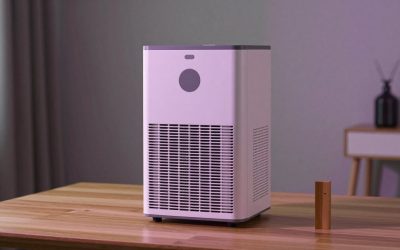
The Ruggard 50L, model EDC-50L, is the mid-size cabinet from the line that dominates this category in US retail. Ruggard’s listing states a 50-liter capacity and a fast-acting TE Cooling Wafer that regulates the interior’s relative humidity from 35 to 60 percent, holding within about 3 percent of the set point. Power consumption is listed at under 8 watts on a 110 to 240 volt, 50/60 Hz multi-voltage supply, so it can run for years on less electricity than a night light uses in months. The door locks with a key, and two keys are included, which makes this the smallest pick here that adds real security against curious hands. Ruggard publishes interior dimensions of 11.3 x 20.9 x 11.4 inches and exterior dimensions of 11.4 x 23.8 x 12.6 inches, a tall, narrow footprint that slides onto a closet shelf or beside a desk. An LCD display shows the interior humidity and temperature. Fifty liters holds one or two bodies and three or four lenses with room for batteries and cards, which is exactly the shape of most enthusiast kits, and the steel-and-glass build feels a clear step up from plastic dry boxes.
Ruggard Electronic Dry Cabinet (80L)

The Ruggard 80L, model EDC-80L, takes the same formula and stretches it for larger kits. The Amazon.com listing states an 80-liter capacity, the same TE Cooling Wafer system holding relative humidity from 35 to 60 percent, and power consumption under 8 watts from the included multi-voltage supply. Interior dimensions are 21.1 x 17.7 x 13 inches, the cabinet weighs 29.5 pounds, and two adjustable steel shelves with fitted foam liners divide the space so bodies, lenses and drives are not stacked against each other. The door is gasket-sealed and key-locked with two keys included, an LCD shows temperature in Fahrenheit or Celsius alongside the humidity reading, and interior LED lighting makes it easy to find a specific lens in a dark room. Ruggard stresses that there is no fan or compressor, so operation is silent, and the design is dripless, with no water tray to empty. Humidity adjustments settle over one to three hours after a change. This is the pick for a working photographer or a household archiving several drives and media collections in one place, where the extra width earns its keep every time something is added.
FORSPARK 100L Camera Dehumidifier Dry Cabinet (FSDCBLK100b)
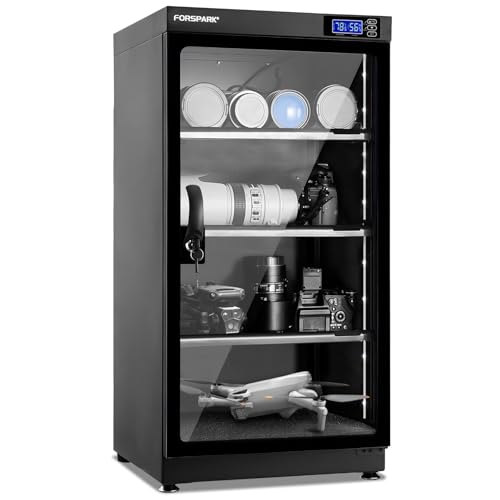
The FORSPARK 100L, model FSDCBLK100b, moves into studio territory. Its published specifications state a 100-liter capacity, a humidity range of 25 to 60 percent RH and an 8-watt draw, with smart control that activates automatically when interior humidity rises above the set level. The frame is cold-rolled steel with a 4-millimeter tempered glass door, the cabinet weighs 14 kilograms (30.8 pounds), and three adjustable shelves divide the interior for bodies, lenses and accessories. The lower 25 percent floor is the headline difference from the Ruggard pair: collections that include film stock, leather cases or older lenses with balsam-cemented elements often target the drier end of the safe band, and this cabinet can hold a set point there. A hundred liters comfortably takes three or four bodies, a shelf of lenses and still leaves room for drones, drives and backup media. One verification note, stated plainly: this model’s ASIN rests on the manufacturer’s manual record rather than a full Amazon.com page read, so confirm the listing details match model FSDCBLK100b before ordering. For a growing collection that has outgrown a 50-liter box, it is the sensible step up.
FORSPARK 125L Dual-Core Camera Dehumidifier Dry Cabinet

The FORSPARK 125L is the largest cabinet here and the only dual-core design. Its listing states a 125-liter capacity, a humidity range of 25 to 60 percent, a 15-watt draw and noise under 30 decibels, so it can run in a studio or bedroom without being heard. Four adjustable shelves create five storage zones, an LED light runs the height of the interior, and the door locks, which matters when the cabinet holds a working studio’s worth of bodies, lenses, drones and collectibles. The cold-rolled steel frame and tempered glass door match the 100L model’s construction, scaled up. The dual-core dehumidifying module is the practical difference at this size: a bigger sealed volume takes longer to pull down after the door has been opened repeatedly, and the second core shortens that recovery so the set point is restored before moisture lingers. Fifteen watts is the highest draw in this roundup, as expected for the biggest cabinet, and still trivial next to any room appliance. Studios storing client drives and backup media alongside camera gear get the most from it, because everything humidity-sensitive can live behind one locked door.
How to choose
Start with capacity, and buy one size larger than today’s kit: 30 liters covers a body and a few lenses, 50 to 80 liters covers an enthusiast or small working kit, and 100 liters and up suits studios and mixed archives of gear, drives and media. Next, check the humidity floor. Most cabinets hold 35 to 60 percent, which is the right band for cameras and electronics; models that reach 25 percent add headroom for film and leather. Then confirm the basics: a gasket-sealed door, a display you can read without opening it, adjustable shelves, and a lock if children or shared spaces are involved. Power draw is small on every pick here, so it should rarely decide the purchase. One safety note deserves care. The big CPSC dehumidifier recalls, covering millions of Gree, Midea and New Widetech compressor room units recalled for fire risk, involve a different product class entirely. Every cabinet in this guide is a compressor-free thermoelectric design, and none of these five models appears in those recall lists, but matching the exact model number against the CPSC database before buying remains a sensible habit.
Who should skip
Skip a dry cabinet if your room already sits below 50 percent humidity year-round, because a simple sealed case with a rechargeable desiccant unit will protect a small kit for far less. Skip one if the problem is a damp room rather than stored gear: these cabinets condition a small sealed volume, not a basement, and a room dehumidifier is the right tool there. Also skip the larger models if your kit is a single camera and lens that you use weekly, since gear in regular use rarely sits still long enough for humidity to harm it.
FAQ
What humidity level should a dry cabinet hold for camera gear?
Most makers and repairers point to a band around 40 to 50 percent relative humidity for cameras and lenses. Sustained levels above 60 percent invite lens fungus and corrosion, while very dry air below roughly 30 percent can, over years, dry out leather coverings and some lubricants. Set the cabinet in the middle of its range and let it hold there.
Can a dry cabinet protect hard drives and electronics too?
Yes. The Ruggard listings name mobile electronics and other valuables among their recommended uses, and the same steady, moderate humidity that protects lenses slows corrosion on drive connectors, circuit boards and media. Keep bare drives in anti-static bags on a padded shelf, and remember a cabinet controls humidity only; it is not a fireproof or theft-proof safe.
Do dry cabinets need emptying or maintenance?
No water tank is involved. Thermoelectric cabinets move moisture out through the dehumidifying module itself, so there is nothing to drain, unlike a compressor room dehumidifier. Maintenance is light: wipe dust from the shelves, keep the door gasket clean so the seal stays tight, and glance at the display now and then to confirm the set point is holding.
Is a dry cabinet better than silica gel in a sealed box?
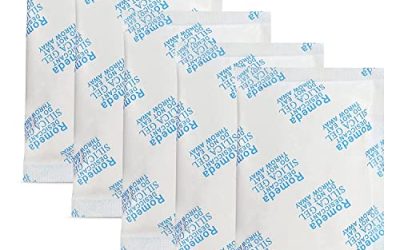
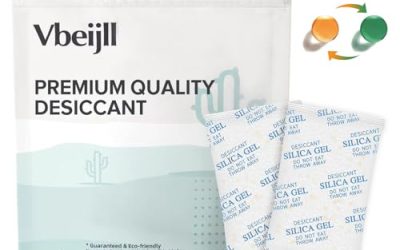
For a single small case, rechargeable silica gel works and costs little, but it saturates silently and must be dried out or replaced on a schedule. A cabinet holds a chosen set point continuously, shows the current humidity on a display and recovers on its own after the door opens. For collections that keep growing, that automation is the real advantage.
Final verdict
For most readers, the Ruggard 50L is the buy: verified listing, locking door, a sensible humidity band and negligible running costs. Choose the AUTENS 30L for a compact first kit, the Ruggard 80L for width and shelf space, and either FORSPARK for the drier 25 percent floor and studio-scale capacity. Any of the five beats a humid shelf.
Product and ASIN Reference
| Product | ASIN |
|---|---|
| AUTENS 30L Dehumidifying Dry Cabinet Box (AD-30L) | B0BL71B3CP |
| Ruggard Electronic Dry Cabinet (50L) | B0784V6V1W |
| Ruggard Electronic Dry Cabinet (80L) | B077SSWTZC |
| FORSPARK 100L Camera Dehumidifier Dry Cabinet (FSDCBLK100b) | B07B6PXGTM |
| FORSPARK 125L Dual-Core Camera Dehumidifier Dry Cabinet | B07T3YGR2M |
More from Amazon
Programs that pair well with the guide above. Offers and eligibility are set by Amazon and may change.
A free business account with business pricing and bulk-buying tools for work, shop or home office.
Create a business accountFree shipping on eligible items, Prime Video and more. Eligible new members can start with a free trial.
Start a Prime free trialAudiobooks and podcasts to listen to on the go. Eligible new members can start with a free trial.
Try Audible freeAd-free music streaming. Eligible new subscribers can start with a free trial.
Try Music Unlimited freeAs an Amazon Associate we earn from qualifying purchases.
Write Your Review
No reviews yet. Be the first to share your experience!