

Our Short List of 3

- Best for: A first printer or classroom machine where forgiving, everyday PLA matters most.
- Material: PLA
- Diameter: 1.75 mm
- Spool weight: 1 kg (2.2 lbs)
- Dimensional accuracy: +/- 0.03 mm
- Best for: Everyday printing where tight tolerance and a low spool cost matter.
- Material: PLA
- Diameter: 1.75 mm
- Spool weight: 1 kg (2.2 lbs)
- Dimensional accuracy: +/- 0.02 mm
- Best for: A brand-new printer owner who wants the most forgiving first spool.
- Material: PLA
- Diameter: 1.75 mm
- Spool weight: 1 kg (2.2 lbs)
- Dimensional accuracy: +/- 0.02 mm
All 5 Picks at a Glance
| Product | Specs | Action |
|---|---|---|
| HATCHBOX PLA Black |
| Check price on Amazon |
| SUNLU PLA Grey |
| Check price on Amazon |
| OVERTURE Easy PLA Red |
| Check price on Amazon |
 eSUN PLA PRO Gray |
| Check price on Amazon |
 Polymaker PolyLite PLA White |
| Check price on Amazon |
Key takeaways
- Compare the best 3D printer filaments for beginners, from forgiving PLA spools to tougher PLA+ options, and pick the spool your first prints deserve.
A beginner’s first filament decision is not really about brand. It is about forgiveness. A spool that flows smoothly at a wide range of temperatures, sticks to the bed without a fight, and survives a few bad settings will teach you more in a week than a fussy engineering plastic will in a month. The wrong first spool turns every print into a troubleshooting session, while the right one lets you learn slicing, bed leveling, and model orientation instead of fighting clogs and warping.
This guide is for people setting up a first FDM printer, parents buying a spool for a teenager’s new machine, and hobbyists who want a reliable everyday plastic without paying for exotic materials. Every filament below was chosen from the name and specifications on its Amazon product page, with the spool size, diameter, tolerance, and recommended temperatures checked against the listing before it made the list.
Quick Picks
As an Amazon Associate we earn from qualifying purchases
| Product | Best for | Key spec from title |
|---|---|---|
| HATCHBOX PLA Black | First printer or classroom machine | 1.75mm Black PLA, 1 KG spool, +/- 0.03 mm |
| SUNLU PLA Grey | Everyday printing on a budget | 1.75mm PLA, 1kg spool, +/- 0.02 mm, Grey |
| OVERTURE Easy PLA Red | Brand-new printer owner | 1.75mm, 1kg cardboard spool, +/- 0.02mm, Easy Red |
| eSUN PLA PRO Gray | Functional parts that get handled | 1.75mm, 1kg, +/- 0.03 mm, Gray |
| Polymaker PolyLite PLA White | Display pieces and miniatures | 1.75mm, 1kg, +/- 0.03mm, White |
How to Choose
Start with the material, not the brand
Plain PLA is the beginner default for a reason. It prints at lower temperatures than most plastics, barely warps, and needs little more than a clean bed to stick. PLA+ is the same base plastic with additives that make finished parts tougher and less likely to snap along layer lines, which suits brackets, hooks, and parts that get handled daily. High-speed PLA is tuned to flow faster for printers that push past normal speeds, but it offers no advantage on a standard machine. Pick plain PLA for learning, PLA+ for parts that take abuse, and high-speed PLA only when your printer can actually use it.
Match the diameter and mind the tolerance
Almost every consumer printer sold today takes 1.75 mm filament, while a few older or larger machines take 2.85 mm, and the two sizes are not interchangeable. Check your printer’s manual before ordering, because a spool of the wrong diameter will not feed at all. Tolerance matters too. A spool rated at plus or minus 0.02 mm holds its diameter more tightly than one rated at plus or minus 0.03 mm, which means steadier extrusion and fewer surprise clogs. For a first spool, 1.75 mm with a stated tolerance of 0.02 or 0.03 mm is the safe choice, and the tighter figure is worth a small premium when two spools are otherwise equal.
Look at the spool, not just the plastic
The spool matters more than most beginners expect. Cardboard spools are lighter and easier to recycle, but they absorb moisture and can warp if stored in a damp room. Plastic spools hold up better in storage and on some automatic material systems, yet they add weight and waste. However the spool is made, the filament should arrive vacuum sealed with a desiccant pack, and it should go back into a sealed bag or dry box between prints. A spool left open on a shelf for weeks will absorb moisture, and damp filament pops, strings, and leaves rough surfaces that no slicer setting can fix.
Choose color and finish with the print in mind
Color is not only decoration. Dark filament hides layer lines and small flaws, which flatters a first print, while white and light colors show every ridge and seam, which helps when you are learning to tune a printer. Matte finishes soften reflections and hide imperfections, while silk and metallic finishes look striking but can be fussier about temperature and speed. Transparent filament shows internal structure and looks great for vases and lamps, yet it also shows every bubble. For a first spool, a plain solid color in black, grey, or red is the most forgiving choice, and specialty finishes are better saved for a second spool once the basics feel easy.
The 5 Best Options
HATCHBOX PLA Black
- Best for: A first printer or classroom machine where forgiving, everyday PLA matters most.
- Material: PLA
- Diameter: 1.75 mm
- Spool weight: 1 kg (2.2 lbs)
- Dimensional accuracy: +/- 0.03 mm
A first printer or classroom machine where forgiving, everyday PLA matters most.
The listing crawl is months old and showed no featured offers, so confirm the spool is in stock before ordering; each HATCHBOX color is a separate listing, so check the color before adding to cart.
HATCHBOX PLA is the spool most beginners meet first, and it earns that place by being boring in the best way. The black 1 kg spool feeds evenly at modest temperatures, sticks to a clean bed with no heated bed required, and produces smooth, glossy parts in a color that forgives layer lines. It has been on sale since 2014, so slicer profiles for it are everywhere, and the dimensional accuracy is tight enough that a first-timer rarely has to chase extrusion settings. This is the budget pick for a first printer, a classroom machine, or anyone who wants a dependable everyday plastic without paying for a premium label.
Watch out for: The listing crawl is months old and showed no featured offers, so confirm the spool is in stock before ordering; each HATCHBOX color is a separate listing, so check the color before adding to cart.
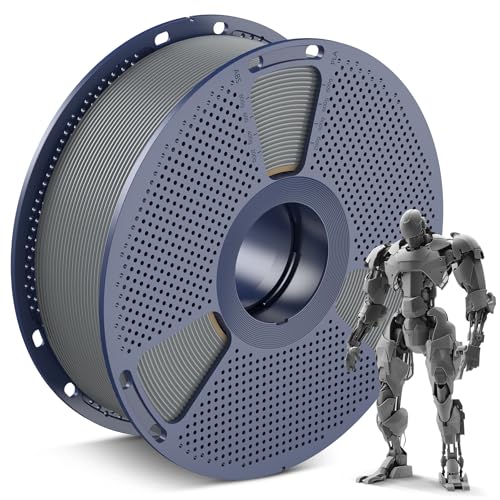
SUNLU PLA Grey
- Best for: Everyday printing where tight tolerance and a low spool cost matter.
- Material: PLA
- Diameter: 1.75 mm
- Spool weight: 1 kg (2.2 lbs)
- Dimensional accuracy: +/- 0.02 mm
Everyday printing where tight tolerance and a low spool cost matter.
Each SUNLU color is a separate listing with its own ASIN, so the black spool is not the same listing as this grey one; confirm the color on the product page before ordering.
SUNLU PLA is the value pick for anyone who prints often and wants the tightest diameter tolerance at a budget price. The grey 1 kg spool is neatly wound, which keeps the filament feeding smoothly instead of tangling mid-print, and the accuracy of plus or minus 0.02 mm is tighter than most spools in this price range. It prints at a nozzle temperature of 200 to 230 degrees with a bed temperature of 50 to 65 degrees, and the spool dimensions are printed on the listing, so checking holder fit takes seconds. Grey sits between black and white: it hides flaws better than white while showing detail better than black.
Watch out for: Each SUNLU color is a separate listing with its own ASIN, so the black spool is not the same listing as this grey one; confirm the color on the product page before ordering.
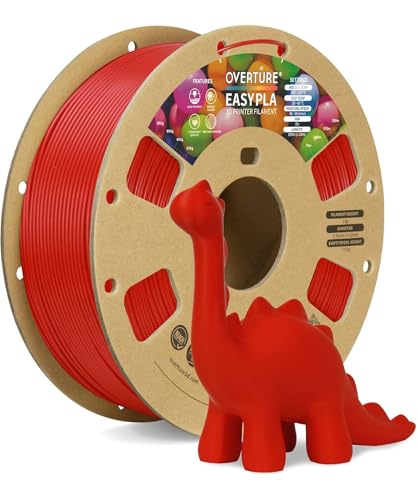
OVERTURE Easy PLA Red
- Best for: A brand-new printer owner who wants the most forgiving first spool.
- Material: PLA
- Diameter: 1.75 mm
- Spool weight: 1 kg (2.2 lbs)
- Dimensional accuracy: +/- 0.02 mm
A brand-new printer owner who wants the most forgiving first spool.
Easy PLA is a separate line from OVERTURE standard PLA, so do not assume settings from the standard spool carry over; store the cardboard spool somewhere dry.
OVERTURE Easy PLA is built for the first weeks of printing, when bed adhesion and tangling cause most failed prints. The red 1 kg spool arrives on a cardboard spool that is lighter than a plastic one, and the filament is wound to resist tangles, which matters when a print runs for hours unattended. OVERTURE describes this line as easier to print with less warping and stronger bed adhesion than its standard PLA, and the listing is sold by OVERTURE 3D and shipped from Amazon. Red is a first color that shows detail well, and the cardboard spool keeps the package light for a shelf or a printer enclosure.
Watch out for: Easy PLA is a separate line from OVERTURE standard PLA, so do not assume settings from the standard spool carry over; store the cardboard spool somewhere dry.
eSUN PLA PRO Gray
- Best for: Functional parts that get handled, flexed, or knocked around.
- Material: PLA+ (PLA PRO)
- Diameter: 1.75 mm
- Spool weight: 1 kg
- Dimensional accuracy: +/- 0.03 mm
Functional parts that get handled, flexed, or knocked around.
The listing carries a California Proposition 65 warning; PLA PRO is tougher than standard PLA but it is still PLA, so do not expect it to survive high heat.
eSUN PLA PRO is the step up for prints that leave the shelf and get used. It is a PLA+ filament, which means the base plastic is modified for higher strength and toughness than standard PLA, so brackets, hooks, and parts that flex or take knocks hold up longer. The grey 1 kg spool comes on a plastic spool that stands up to repeated handling and storage, and the dimensional accuracy of plus or minus 0.03 mm keeps extrusion steady across long prints. This is the mid-range pick for functional parts, and the grey color hides wear better than white while showing enough detail to spot a bad layer.
Watch out for: The listing carries a California Proposition 65 warning; PLA PRO is tougher than standard PLA but it is still PLA, so do not expect it to survive high heat.
Polymaker PolyLite PLA White
- Best for: Display pieces, miniatures, and decorative prints where a crisp finish matters.
- Material: PLA (PolyLite)
- Diameter: 1.75 mm
- Spool weight: 1 kg
- Filament length: 320 m
Display pieces, miniatures, and decorative prints where a crisp finish matters.
The listing crawl is months old and showed no featured offers, so confirm the spool is in stock before ordering; white shows every flaw, so tune settings on a test print first.
PolyLite PLA is the premium pick for prints where the finish is the point. Polymaker builds this white 1 kg spool for rigidity, so display pieces, miniatures, and decorative parts hold crisp edges instead of flexing, and the dimensional accuracy is measured with a CCD line sensor, with most filament within plus or minus 0.01 mm. The spool is recycled cardboard, the filament length is 320 meters, and the recommended settings are a 210 degree nozzle, a 50 degree bed, and 60 millimeters per second. White is the hardest color to print cleanly because it shows every flaw, which makes this spool a good test of a tuned printer.
Watch out for: The listing crawl is months old and showed no featured offers, so confirm the spool is in stock before ordering; white shows every flaw, so tune settings on a test print first.
Which One Fits Your Situation
Setting up your very first printer
Buy the HATCHBOX black PLA. It prints at modest temperatures, needs no heated bed, and the black color forgives the layer lines that every first print has. Keep the first models small — a calibration cube, a benchy, a simple hook — and learn bed leveling and slicing before trying anything exotic. One spool is enough for weeks of learning, and the profiles for this filament are easy to find.
Printing every day on a budget
Pick the SUNLU grey PLA or the OVERTURE Easy PLA in red. Both are budget spools with tight tolerances, and either one will carry a daily printing habit without constant troubleshooting. SUNLU suits printers where the spool dimensions matter, since the listing states them, while OVERTURE Easy PLA suits a brand-new owner who wants the most forgiving first spool. Whichever you choose, buy a second spool before the first runs out, because a mid-print empty spool wastes hours.
Making parts that get used, not just displayed
Choose the eSUN PLA PRO in grey. PLA+ handles bumps, flexing, and daily use better than standard PLA, so brackets, hooks, and replacement parts last longer. Keep the nozzle and bed settings in the PLA range rather than pushing toward ABS temperatures, and remember that PLA still softens in a hot car, so do not use it for parts that live in high heat. For anything load-bearing, print with more walls and infill rather than relying on the material alone.
Printing display pieces and miniatures
Go with the Polymaker PolyLite PLA in white. Its rigidity holds sharp edges on miniatures and decorative parts, and the tight dimensional accuracy keeps small details consistent from layer to layer. White shows every flaw, so run a small test print first and tune the settings before starting a long model. If white feels too unforgiving, the HATCHBOX black PLA is the safer display choice, since dark filament hides layer lines that white would show.
Common Mistakes
- Ordering 2.85 mm filament for a printer that takes 1.75 mm, or the reverse.
- Leaving a spool open on a shelf for weeks and printing with damp filament.
- Treating every PLA spool as identical and skipping the recommended nozzle and bed temperatures on the listing.
- Buying a color or finish for looks without checking whether the listing is a different product, since each color is usually a separate listing.
- Starting a long print with a nearly empty spool and running out of filament mid-print.
Frequently Asked Questions
What is the easiest filament for a beginner?
Plain PLA is the easiest filament for a beginner. It prints at lower temperatures than most plastics, barely warps, and sticks to a clean bed with little fuss. PLA+ adds toughness for parts that get handled, but it is slightly fussier to tune. Start with plain PLA, learn slicing and bed leveling, and move to PLA+ once basic prints come out clean.
Does filament diameter really matter?
Yes. Almost every consumer printer takes 1.75 mm filament, while a few machines take 2.85 mm, and the two sizes do not fit the same extruder. Check your printer manual before ordering, because the wrong diameter will not feed at all. Within the right diameter, tolerance matters too: a spool rated at plus or minus 0.02 mm feeds more evenly than one rated at plus or minus 0.03 mm.
How should I store filament between prints?
Keep filament dry and sealed. Store spools in a sealed bag or dry box with desiccant, and keep them out of damp rooms and sun. Filament left open absorbs moisture, and damp filament pops and strings during printing and leaves rough, bubbly surfaces. If a spool has been open for weeks, dry it in a filament dryer or an oven before printing, and check the listing for storage guidance first.
Can I print PLA without a heated bed?
Yes, many PLA spools print with no heated bed, and HATCHBOX lists no heated bed as necessary for its PLA. A clean bed, a level first layer, and the recommended nozzle temperature matter more than bed heat for small PLA prints. A heated bed can still help larger prints stick, but it is not required. If a print lifts at the corners, check bed leveling and cleanliness before changing temperatures.
More from Amazon
Programs that pair well with the guide above. Offers and eligibility are set by Amazon and may change.
A free business account with business pricing and bulk-buying tools for work, shop or home office.
Create a business accountFree shipping on eligible items, Prime Video and more. Eligible new members can start with a free trial.
Start a Prime free trialAudiobooks and podcasts to listen to on the go. Eligible new members can start with a free trial.
Try Audible freeAd-free music streaming. Eligible new subscribers can start with a free trial.
Try Music Unlimited freeAs an Amazon Associate we earn from qualifying purchases.

Write Your Review
No reviews yet. Be the first to share your experience!