

Key takeaways
- Five extension tubes that turn a lens you own into a close-up tool. Compare auto and manual sets for Canon, Nikon, Sony, and Fujifilm mounts.
A dedicated macro lens is the easy answer to close-up photography, and it is also the expensive one. An extension tube takes the other route: a hollow spacer that sits between the camera body and the lens, pushes the lens farther from the sensor, and lets that lens focus much closer than it was built to. There is no glass inside, so the sharpness of your lens stays intact, but the trade is real too. Light is lost, distant focus disappears while the tubes are mounted, and the wrong mount or the wrong contacts turn a bargain into a paperweight.
This guide covers five sets chosen from names and specs on Amazon listings, one for each of the big mounts: Canon EF, Nikon F, Sony E, and Fujifilm X, plus a manual Canon set for shooters who want the cheapest way in. Four of the five carry electronic contacts that keep autofocus and aperture control alive, and one does not, so the auto-versus-manual split runs through the whole guide.
Quick Picks
As an Amazon Associate we earn from qualifying purchases.
| Product | Best for | Key spec from title |
|---|---|---|
| Kenko DG Canon EF | Canon DSLR shooters who want three lengths | 12mm, 20mm, and 36mm auto tubes |
| Mcoplus Extnp Nikon F | Nikon DSLR owners on a budget | 12mm, 20mm, and 36mm auto tubes |
| Meike MK-S-AF3A Sony E | Sony mirrorless shooters trying macro | 10mm and 16mm auto tubes |
| Fujifilm MCEX-11 | Fujifilm X shooters who want the maker tube | 11mm tube with electronic contacts |
| Fotodiox EF-MCR Canon | Canon shooters who want the cheapest manual set | 7mm, 14mm, and 28mm all-metal tubes |
How to Choose
Match the Mount First
Every tube in this guide is built for one camera mount, and a tube for one mount does not fit another. A Canon EF set will not mount on a Nikon F body, a Sony E set will not mount on a Fujifilm X body, and no adapter fixes that, because the tube itself is the mount. Begin with the letters on your camera body. A set made for full-frame bodies also works on crop-sensor cameras of the same mount, while the reverse is not always true, and a tube sold for a crop-sensor body can darken the corners on a full-frame sensor. Confirm the exact mount in the listing selector, since sellers list several mounts under near-identical names.
Auto Contacts or Plain Metal
Automatic tubes carry electrical contacts through the spacer, so the camera still controls autofocus, exposure, and the aperture. Plain tubes have no contacts and cost much less, but the camera loses touch with the lens entirely. That matters most with modern lenses, which have no aperture ring: on a plain tube, the lens stays wide open, and the sharp zone becomes paper-thin. Autofocus matters less than most buyers expect, because close-up shooters usually focus by moving the camera, but aperture control matters more, because stopping down is how depth of field is bought back. Plain tubes still make sense for old manual lenses with an aperture ring, or for a cheap first try.
How Much Extension You Need
Extension length is the only number that sets magnification: the magnification a tube adds is roughly its length divided by the lens focal length. A 25mm stack adds about half life-size to a 50mm lens, but only about a quarter on a 100mm lens. Short primes and the wide end of mid-range zooms gain the most, while long telephotos gain little. Sets in this guide run from a single 11mm tube to a three-tube stack of 68mm, and every set can be used one tube at a time or stacked. Stacking adds reach and costs light, so buy the lengths that match the lens you actually own, not the longest stack on the page.
Build, Weight, and the Stack
A tube holds a lens away from the body, so the mount takes the load. Metal mounts hold up better than plastic, and each tube in a good set carries its own camera plate at the back and lens plate at the front, with a lock and release pin. Cheaper sets share one pair of mount rings across three tubes, so changing lengths means unscrewing the rings. Weight matters too, because a stacked set plus a heavy lens hangs off the body mount, and a wobble at the joint softens images. Check the tube diameter too: a 68mm or 69mm barrel suits a full-frame DSLR, while a slimmer 57mm barrel suits a small mirrorless body.
The 5 Best Options
Kenko DG Canon EF

Kenko has sold this DG set for years, and it is the most established three-tube kit in the guide. The Canon EF version gives a DSLR shooter 12mm, 20mm, and 36mm tubes that can be used alone or stacked in any order, with full electronic pass-through so autofocus and TTL auto exposure keep working with most Canon lenses. Each tube has its own camera and lens mounting plates, complete with lock and release pins, so changing lengths is a twist, not a rebuild. The tubes are made in Japan with metal mounts, and the 12mm tube weighs the same 2.2 ounces as the Canon original it mirrors.
Specs
- Tube lengths: 12mm, 20mm, 36mm, usable alone or stacked to 68mm
- Mount: Canon EF, with circuitry and mechanical coupling for autofocus and TTL auto exposure
- Optics: none, so the lens supplies all image formation
- Mount material: metal, each tube with its own camera and lens plates
- Made in Japan
- 12mm tube weight: 2.2 oz
Best for: Canon DSLR shooters who want the most flexible three-length auto set.
Watch out for: older DG sets are not Canon EF-S compatible, and later versions reportedly added EF-S alignment markings, so confirm the exact listing covers your lens before buying.
Mcoplus Extnp Nikon F

The Mcoplus Extnp is the budget way into macro for a Nikon DSLR, and its electronics are the whole point of buying it rather than a plain metal ring. The three tubes carry contacts that pass autofocus and aperture control to AF-S and G lenses, which matters, because those lenses have no aperture ring. The set covers Nikon AF, AF-S, DX, and FX SLR bodies, and the 12mm, 20mm, and 36mm tubes can be used alone or combined for seven different extension combinations. The barrel is brass chromed and ABS at 69mm across, which suits a full-size DSLR body.
Specs
- Tube lengths: 12mm, 20mm, 36mm, usable alone or combined
- Mount: Nikon F, for Nikon AF, AF-S, DX, and FX SLR cameras
- Contacts: electronic, passing autofocus and aperture control to AF-S and G lenses
- Construction: brass chromed and ABS
- Barrel diameter: 69mm
Best for: Nikon DSLR owners on a budget who shoot AF-S or G lenses.
Watch out for: autofocus needs a narrow band of subject distance to lock, roughly 1 to 3 cm, and with all three tubes stacked the maker suggests switching to manual focus.
Meike MK-S-AF3A Sony E

Sony mirrorless owners get the shortest tubes in the guide with the Meike MK-S-AF3A. The pair is a 10mm and a 16mm tube that can be used alone or stacked for 26mm of extension, and both carry gold contacts so autofocus, aperture control, and lens data keep working on Sony E and FE bodies, APS-C and full-frame alike. The bayonet is metal while the body is plastic, which keeps the set light: the 10mm tube weighs about 48 grams and the 16mm about 70 grams. The lens focal length should be greater than the tube length in use, so a 50mm lens is the natural partner.
Specs
- Tube lengths: 10mm and 16mm, stackable to 26mm
- Mount: Sony E and FE, for APS-C and full-frame mirrorless cameras
- Contacts: gold-plated, passing autofocus, aperture control, and lens data
- Build: metal bayonet, plastic body
- Weight: 10mm tube about 48 g, 16mm tube about 70 g
- Date first available: December 15, 2016; not discontinued by the maker
Best for: Sony E-mount shooters taking a low-risk first step into macro.
Watch out for: the tubes are short, so a long telephoto gains little, and autofocus tends to hunt at such close range, so expect to focus by hand on tight subjects.
Fujifilm MCEX-11
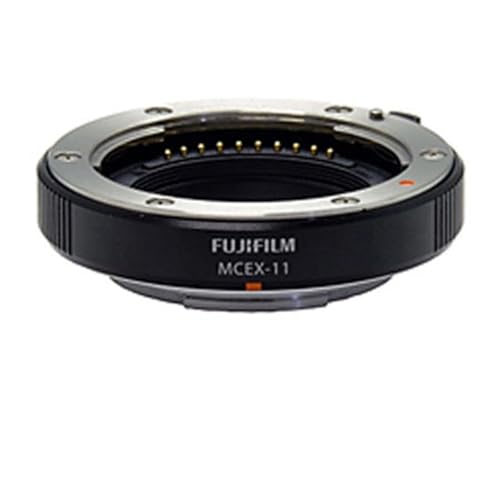
Fujifilm makes its own tube for X-series cameras, and the MCEX-11 is the single most purpose-built pick in this guide. It is one 11mm tube, not a set, with a solid metal mount ring and electronic contacts that pass information between Fujinon X-mount lenses and the body, so autofocus and auto exposure keep working while it is mounted. Fujifilm publishes a chart of magnification, working distance, and shortest shooting distance for every XF lens with the tube fitted, and some lens pairings are greyed out, so the lens should be looked up before buying. The tube weighs 3.2 ounces and carries part number 16451720.
Specs
- Extension length: 11mm
- Mount: Fujifilm X-mount, for XF and XC lenses and X-series cameras
- Contacts: electronic, passing autofocus and auto exposure
- Mount material: metal mount ring
- Weight: 3.2 oz
- Dimensions: 3.3 x 3 x 1.5 in
- Part number: 16451720
Best for: Fujifilm X shooters who want the maker’s own tube and its published lens chart.
Watch out for: this is a single tube, so stacking means buying the 16mm MCEX-16 sibling separately, and the two sell under near-identical names, so confirm the 11mm listing.
Fotodiox EF-MCR Canon

The Fotodiox EF-MCR is the cheapest way into macro in this guide. Three plain metal tubes of 7mm, 14mm, and 28mm carry no electronic contacts at all, so the shooter focuses by hand by moving the camera, and a modern EF lens stays at its widest aperture, which leaves a razor-thin sharp zone. That is fine for a quick experiment or for flat subjects, and the all-metal build with no glass means the lens keeps its original optical quality. The set has five components: three tubes plus a camera mounting ring and a lens mounting ring, and the rings screw onto whichever tube is in use.
Specs
- Tube lengths: 7mm, 14mm, and 28mm
- Mount: Canon EF and EF-S, for Canon EOS cameras
- Contacts: none; manual focus and manual exposure, or aperture-priority metering
- Construction: all metal, no optical elements
- Components: three tubes plus camera and lens mounting rings
- Weight: 3.5 oz
Best for: Canon shooters who want the cheapest manual set for a first macro experiment.
Watch out for: the mount ring can bind on the camera body, and swapping tubes means unscrewing the shared mount rings, so budget extra time for every length change.
Which One Fits Your Situation
You Shoot Canon DSLRs
The Kenko DG is the pick for a Canon DSLR shooter who wants the set to disappear into the workflow. Three lengths, full contacts, and a mount on every tube mean the camera still behaves like a camera, with autofocus and aperture control intact. The Fotodiox manual set is the alternative when the budget is the whole point, but it asks for a lens with a mechanical aperture ring or a willingness to shoot wide open.
You Shoot Nikon DSLRs
The Mcoplus Extnp exists for one reason: Nikon AF-S and G lenses have no aperture ring, so a plain tube leaves no way to stop down. Its contacts pass aperture control through, which makes it the only sensible budget choice for most Nikon DSLR owners. A Kenko DG set for Nikon F is the established alternative, with mechanical linkages for older screw-drive lenses, but it costs more for the same three lengths.
You Shoot Mirrorless
Mirrorless shooters get the most from the shortest tubes, because the bodies are smaller and the mounts are newer. The Meike pair suits Sony E and FE bodies with 10mm and 16mm of extension and working contacts, while the Fujifilm MCEX-11 is the single-tube answer for X-series cameras, with the maker’s own compatibility chart behind it. Either way, confirm the mount letters first, since a Sony tube will not fit a Fujifilm body.
You Want the Cheapest First Try
The Fotodiox manual set is the cheapest honest entry in this guide, and it is the right buy when the goal is learning what extension does rather than shooting a finished portfolio. Use it with a lens that has a mechanical aperture ring, light the subject hard, and focus by moving the camera. If the razor-thin sharp zone frustrates you, that frustration is the signal to move up to an automatic set.
Common Mistakes
- Buying a tube for the wrong mount, then discovering that no adapter can fix it, because the tube itself is the mount.
- Picking a plain manual set for a modern lens with no aperture ring, then finding the lens stuck wide open with a paper-thin sharp zone.
- Stacking every tube at once and expecting autofocus to work, when the light loss and the sliver of focus make the camera hunt.
- Confusing an extension tube with a teleconverter or a close-up filter: a tube has no glass and only shortens focus distance, while a teleconverter adds glass and focal length, and a filter screws onto the front of the lens.
- Forgetting that infinity focus is gone while tubes are mounted, so the lens cannot focus on anything distant until the tubes come off.
Frequently Asked Questions
Do extension tubes reduce image quality?
No, because a tube contains no glass at all. It is a hollow spacer that moves the lens farther from the sensor, so the sharpness of the lens itself stays intact. What changes is light and focus: less light reaches the sensor, the viewfinder turns dimmer, and the lens can no longer focus at a distance while the tubes are mounted.
Can I use extension tubes with a zoom lens?
Yes, and most buyers do, because a zoom is the lens already in the bag. Short primes and the wide end of a mid-range zoom gain the most magnification from a given tube length, while a long telephoto gains little. One caution applies: the lens focal length should be longer than the tube length in use, so a 10mm tube suits a 50mm lens far better than a 24mm one.
Will autofocus still work with extension tubes?
It depends on the contacts. Automatic tubes pass autofocus and aperture signals through, so the camera still focuses, though it hunts more at close range and may miss when several tubes are stacked. Plain manual tubes carry no signals, so autofocus stops entirely and the shooter focuses by moving the camera. Most close-up shooters focus by hand anyway, since moving the camera gives finer control than the focus ring.
Are extension tubes a replacement for a macro lens?
For casual close-ups they are, and for regular macro work they are not. A tube turns a lens you own into a close-focusing tool for very little money, ideal for occasional flowers, insects, and small objects. A true macro lens focuses from infinity to life-size without accessories, holds its aperture, and works in low light, so anyone shooting macro every week will find the dedicated lens easier to live with.
More from Amazon
Programs that pair well with the guide above. Offers and eligibility are set by Amazon and may change.
A free business account with business pricing and bulk-buying tools for work, shop or home office.
Create a business accountFree shipping on eligible items, Prime Video and more. Eligible new members can start with a free trial.
Start a Prime free trialAudiobooks and podcasts to listen to on the go. Eligible new members can start with a free trial.
Try Audible freeAd-free music streaming. Eligible new subscribers can start with a free trial.
Try Music Unlimited freeAs an Amazon Associate we earn from qualifying purchases.

Write Your Review
No reviews yet. Be the first to share your experience!