

Key takeaways
- Five chemical resistant gloves for workshop, lab and cleaning work, from reusable 15 mil nitrile gauntlets to chemo-tested exam gloves, ranked.
Solvents, acids, cleaning chemicals and oily parts all punish bare hands, and the wrong glove is worse than no glove when it lets a chemical through without you noticing. A good chemical resistant glove is a barrier you can trust for a stated job, in a material matched to the chemical, with a cuff long enough to keep splashes off your forearm. This guide covers five gloves across workshop, lab and cleaning work, from heavy reusable nitrile gauntlets to a thin exam glove tested against chemotherapy drugs.
As an Amazon Associate, we earn from qualifying purchases.
Quick answer
For workshop and cleaning work, the Ansell AlphaTec Solvex 37-175 and the SHOWA 730 are the best picks: both are 15 mil nitrile gauntlets with flock linings. For lab work, the Kimberly-Clark Purple Nitrile exam glove is the thinnest barrier here, with chemotherapy-drug testing. The SAS Raven 7 mil glove is the tougher disposable for automotive jobs, and the SHOWA 737 is thickest at 22 mil.
Ansell AlphaTec Solvex 37-175 Flocked Chemical Resistant Gloves
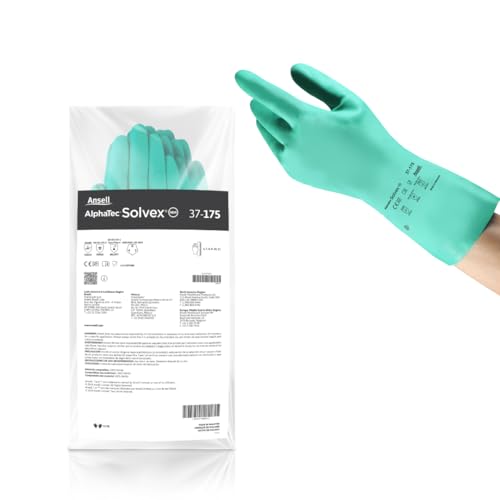
The Ansell AlphaTec Solvex 37-175 is the reference glove industrial hygiene programs write into their procedures: a 15 mil nitrile shell, a 13-inch gauntlet, and a cotton flock lining that makes a heavy glove comfortable for a full shift. Ansell publishes permeation data for this line against its own chemical guide, so you can check a specific chemical against a documented breakthrough time
The flocked interior separates the 37-175 from its unflocked sibling, the 37-155. Cotton flock absorbs sweat and lets the glove slide on and off easily, but it holds moisture, so air dry the glove between uses. The green shell has a sandpatch-style finish that grips wet and oily parts without the slick feel of a smooth dipped glove.
Ansell rates the 37-175 for EN 374 Type A chemical protection and food handling under FDA rules. It is latex-free and powder-free. This listing is the Large size in a 12-pair pack, model 37175. Confirm the size before ordering, since the same model comes in sizes 7 through 11, and a too-tight gauntlet tears at the cuff while a loose one snags on machinery.
SHOWA 730 Chemical Resistant Gloves
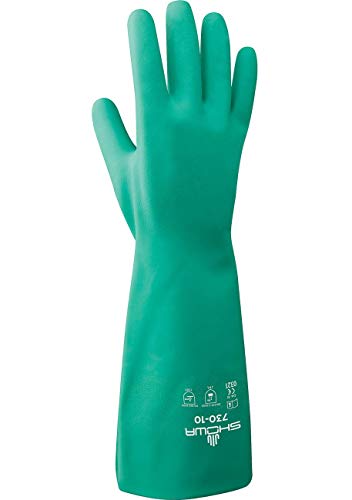
The SHOWA 730 shares the same core recipe as the Ansell: 15 mil of nitrile, a 13-inch gauntlet, and a cotton flock lining. Where it differs is the grip. SHOWA calls its finish a bisque grip, a textured surface that holds oily and wet parts securely, and the glove carries a CE Category III rating with EN ISO 374 Type A chemical protection.
The 730 is unsupported nitrile, with no fabric backing, so the flock lining is the only layer between your hand and the nitrile. That keeps the glove flexible and dexterous for a 15 mil glove, and SHOWA lists it as food safe with FDA approval, so it works for food packing and handling as well as chemical spray work and cleaning.
This listing is the Large size, model 730-09, in a 12-pack. SHOWA rates the 730 at ANSI abrasion level 4, cut level 0 and puncture level 1, strong against abrasion and chemicals, not a cut glove. Do not use it where a blade or sharp edge is the main hazard. The glove is reusable, so inspect it before each use and retire any pair with cracks, swelling or thinning at the fingertips.
SHOWA 737 Nitrile Chemical Resistant Gloves

The SHOWA 737 is the thickest glove in this roundup at 22 mil, and it is the pick for immersion-style work where a glove sits in a chemical bath or handles soaked parts for extended periods. At 22 mil, nitrile buys longer breakthrough times against many chemicals than the 15 mil gauntlets, and the 737 stretches that protection to a 15-inch cuff, so splashes have further to travel before they reach skin.
Unlike the 730, the 737 is unlined, with no cotton flock inside. That makes it easier to rinse clean and faster to dry, and it removes the damp-flock problem on long wet jobs, but it also means the glove can feel clammy against bare skin and is harder to pull on with sweaty hands. SHOWA lists the 737 as food safe with the same EN ISO 374 Type A rating.
This listing is the Large size, model 737-09, in a 12-pair pack. The verification for this pick rests on a CamelCamelCamel record naming Amazon, with Amazon rows current in the spring of 2026, so the gate should open the product page and confirm a buyable offer before publishing. The 737 is the weakest pick in this set by verification tier, and its extra thickness costs dexterity.
Kimberly-Clark Purple Nitrile Exam Gloves

The Kimberly-Clark Purple Nitrile exam glove is a different class of protection from the gauntlets above, and it earns its place here on documented testing rather than thickness. At 5.9 mil, it is a thin disposable exam glove, but it is tested for use with chemotherapy drugs, the opioid fentanyl, gastric acid, and fentanyl in gastric acid under FDA clearance K200072. That makes it the pick for lab work, inspection, and handling hazardous powders where dexterity matters more than immersion protection.
The glove is powder-free, latex-free, non-sterile and ambidextrous, with textured fingertips and a beaded cuff, in a 9.5-inch length. The purple color makes a torn or punctured glove easy to spot against skin or a light work surface. The premium AQL 1.5 rating means the pinhole rate is held to a tight standard.
This listing is the Medium size, model 55082, in a box of 100. Sizes run from XS at 55080 through XL at 55084, so confirm the model number matches the size you need. A thin disposable glove is single-use by design, so never reuse one after chemical contact, and never use it in place of a gauntlet for immersion or heavy splash.
SAS Raven Powder-Free Nitrile Disposable Gloves
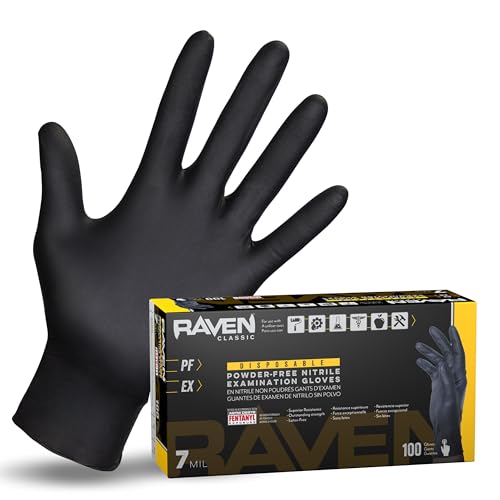
The SAS Raven is the workhorse disposable in this group. At 7 mil, it is noticeably thicker than a standard exam glove, which buys extra puncture resistance and a longer working life per glove, while staying thin enough for automotive, janitorial and food service work. SAS markets it as chemical and puncture resistant with a textured grip, and the black color hides grease and grime.
The Raven is powder-free and latex-free, with an exam-grade rating, and it comes in a box of 100 gloves by weight. The 7 mil thickness survives brake cleaner, solvents, adhesives and oily parts without tearing on the first pull, and the textured surface keeps a grip on wet fasteners and tools. This listing is the Medium size, model 66517, and the box weighs 1.5 pounds.
The listing data used does not state a length or a cuff style beyond the standard exam-glove form, so confirm the cuff length on the product page if you need splash protection past the wrist. Like every disposable here, it is single-use: once it has touched a chemical, it goes in the waste, and a fresh pair goes on. Do not substitute a different Raven size or thickness without checking the model number.
How to choose
Start with the chemical, not the glove. Nitrile handles a wide range of oils, fuels, solvents and many acids and bases, but no single material resists everything: acetone and dichloromethane break through nitrile far faster than many users expect. Check the maker’s permeation chart for your exact chemical and concentration.
Next, match thickness to the job. A 5.9 mil exam glove is for inspection, lab work and light contact. A 7 mil disposable is for automotive and janitorial work with real puncture risk. A 15 mil gauntlet is for cleaning, spraying and handling soaked parts. A 22 mil gauntlet is for immersion and extended contact. Thicker gloves protect longer but cost dexterity.
Then check the cuff. A 9.5-inch exam glove protects the hand. A 13-inch gauntlet protects the wrist and forearm. A 15-inch gauntlet protects further up the arm. For tank work, spraying overhead, or liquids that can run down your arm, the longer cuff is not optional. Finally, confirm sizing: too tight tears at the cuff, too loose snags on machinery and loses grip.
Who should skip
Skip the reusable gauntlets if your work is mostly fine assembly, electronics or small fasteners: at 15 to 22 mil, these gloves trade dexterity for protection, and you will work slower and drop more parts. Skip the thin exam gloves if the job involves immersion, heavy splash, or sustained contact with solvents: a 5.9 mil disposable is a barrier for inspection and light contact, not a substitute for a gauntlet, and reusing one after chemical contact is unsafe.
Skip any glove in this group if you have not checked it against your chemical. Nitrile is not a universal barrier, and a glove that resists one solvent can fail quickly against another. People with latex allergies are safe with all five picks here, since every one is latex-free, but anyone with a nitrile sensitivity should look at neoprene or butyl alternatives instead. And skip disposable gloves entirely for work near rotating machinery: a loose cuff can catch, so gauntlets with a snug fit are the safer choice there, and even then, keep hands clear of moving parts.
Frequently asked questions
Are nitrile gloves safe for all chemicals?
No. Nitrile resists a wide range of oils, fuels, solvents and many acids and bases, but it is not a universal barrier. Some solvents, including acetone and dichloromethane, break through nitrile quickly. Always check the maker’s permeation chart for your exact chemical and concentration before you start work.
How long can I wear a reusable chemical glove?
A reusable gauntlet lasts until it shows damage, not for a fixed number of uses. Inspect it before every use for cracks, swelling, thinning or stiffness, and retire any pair that shows those signs. Rinse it after use and air dry it fully.
Can I reuse a disposable nitrile glove?
No. Disposable gloves are single-use by design. Once a disposable glove has touched a chemical, the material may already be compromised even if it looks intact, and putting it back on risks skin contact with whatever it absorbed.
What is the difference between the SHOWA 730 and the SHOWA 737?
The 730 is a 15 mil flocked gauntlet with a 13-inch cuff, built for comfort and grip on cleaning and spray work. The 737 is a thicker 22 mil unlined gauntlet with a 15-inch cuff, built for immersion and extended contact. The 737 protects longer against many chemicals but is stiffer and less dexterous, so pick the 730 for general work and the 737 for extended chemical contact.
Final verdict
For most workshop and cleaning work, the Ansell AlphaTec Solvex 37-175 is the best all-round pick: a proven 15 mil nitrile gauntlet with a comfortable flock lining, documented chemical data, and a food-safe rating. The SHOWA 730 is a near-equal alternative with a better grip texture, and the SHOWA 737 is the choice when the job calls for maximum thickness and the longest cuff. For lab and inspection work, the Kimberly-Clark Purple Nitrile exam glove is the thinnest barrier here with the strongest documented testing, while the SAS Raven 7 mil disposable is the tougher everyday glove for automotive jobs.
Product and ASIN Reference
| Product | ASIN |
|---|---|
| Ansell AlphaTec Solvex 37-175 Flocked Chemical Resistant Gloves | B0856S5XPY |
| SHOWA 730 Chemical Resistant Gloves | B007VR5ETC |
| SHOWA 737 Nitrile Chemical Resistant Gloves | B007VR5HR6 |
| Kimberly-Clark Purple Nitrile Exam Gloves | B0015TF3CA |
| SAS Raven Powder-Free Nitrile Disposable Gloves | B002XXO5US |
More from Amazon
Programs that pair well with the guide above. Offers and eligibility are set by Amazon and may change.
A free business account with business pricing and bulk-buying tools for work, shop or home office.
Create a business accountFree shipping on eligible items, Prime Video and more. Eligible new members can start with a free trial.
Start a Prime free trialAudiobooks and podcasts to listen to on the go. Eligible new members can start with a free trial.
Try Audible freeAd-free music streaming. Eligible new subscribers can start with a free trial.
Try Music Unlimited freeAs an Amazon Associate we earn from qualifying purchases.
Write Your Review
No reviews yet. Be the first to share your experience!