

Key takeaways
- Compare the best camera cleaning kits for DSLR and mirrorless cameras, covering sensor swabs, air blowers, lens pens, cleaning fluids, and cloths.
Dust spots in a clear sky, fingerprints on a front element, and grit around a focus ring all come from the same place: everyday handling. A complete camera cleaning kit puts the right tool for each job in one case, so loose dust is blown away before anything touches glass, smudges are lifted with fluid and cloth, and sensor spots are handled with swabs sized to the sensor. The five kits below cover full-frame and APS-C cameras, mixed kits with both swab widths, and one lens-only set for owners who leave sensor work to a service center.
As an Amazon Associate, we earn from qualifying purchases.
Quick answer
For most DSLR and mirrorless owners, the KuuZuse Professional kit is the most flexible pick because it carries both 16mm and 24mm sensor swabs. Full-frame owners who clean often should look at the swab-heavy UES 21-in-1, APS-C owners at the Movo Deluxe Essentials, and anyone avoiding sensor work at the lens-only Celestron kit.
KuuZuse Professional DSLR Camera Cleaning Kit

Specs
- 30 ml lens cleaner solution, air blower, double-sided cleaning pen, cleaning brush, microfiber cloths in 9 by 9 inch and 6 by 6 inch sizes, 5 depuration sponge swabs, 4 sensor cleaning swabs at 16mm, 1 sensor cleaning swab at 24mm, carrying bag, UPC 758035414070.
The KuuZuse kit stands out in this group because it is the only set here that includes sensor swabs in both common widths. The four 16mm swabs suit APS-C bodies, while the single 24mm swab covers a full-frame sensor, which makes the kit a sensible choice for a household or a small studio running both formats. The listing describes the kit as compatible with most DSLR cameras, especially those with APS-C sensors.
Everyday lens care is covered by the 30 ml bottle of lens cleaner, two sizes of microfiber cloth, a cleaning brush, and a double-sided pen. The listing gives two usage notes worth following: never spray the cleaner directly onto a lens, always apply it to a cloth first, and keep the lens dry when using the pen. Five sponge swabs handle edges and mounts where cloth cannot reach.
The trade-off is depth. With only one full-frame swab in the bag, full-frame owners who wet-clean often will burn through the headline feature quickly and need a separate swab pack, while APS-C owners get a more generous supply.
UES 21-in-1 Camera Cleaning Kit
Specs
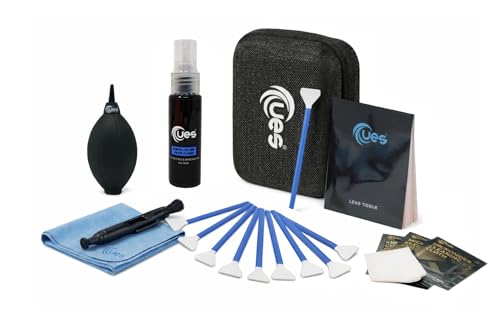
- 10 full-frame sensor cleaning swabs, 5 lens cleaning cloths, air blower, lens cleaning pen, lens and sensor liquid cleaner, lens cleaning paper, screen cleaning cloth, 21 pieces in total.
UES built this kit around one job: repeated full-frame sensor cleaning. Ten 24mm swabs is the largest swab count in this roundup, and for photographers who change lenses outdoors and deal with dust spots regularly, that supply matters more than extra accessories. Separate liquid cleaner is included for the lens and the sensor, so the fluid used on a swab is not the same bottle used on a front element.
Around that core, the kit covers the standard routine. The air blower clears loose dust before anything makes contact, the lens pen handles fingerprints on glass, the five cloths and the lens cleaning paper cover wiping tasks, and a dedicated screen cloth keeps the rear display separate from the cloths used on coated optics.
The limitation is format. Every swab in the box is full-frame width, and there are no 16mm swabs for APS-C bodies, so crop-sensor owners should look at the Movo or KuuZuse kits instead. There is also no hard case listed among the contents, so the pieces need a clean pouch or drawer of their own to stay dust-free between uses.
Movo Deluxe Essentials DSLR Camera Cleaning Kit
Specs
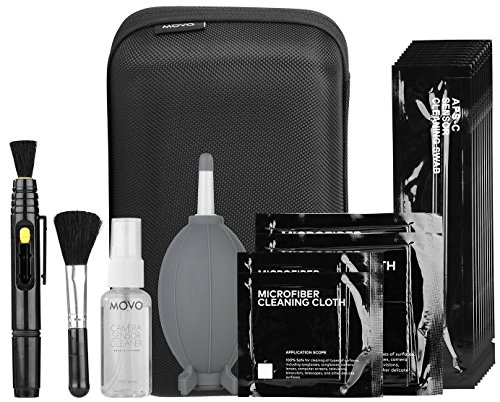
- 10 APS-C cleaning swabs, sensor cleaning fluid, rocket air blower, lens pen, soft brush, 2 small and 2 large microfiber cloths, carrying case.
Where the UES kit serves full-frame owners, the Movo Deluxe Essentials is the APS-C counterpart. Its ten swabs are sized for crop sensors, and the rest of the kit follows the same complete pattern: sensor cleaning fluid for wet passes, a rocket-style air blower for the first dry step, a lens pen for smudges, and a soft brush for the body and lens barrel.
The cloth supply is better thought out than most. Two small and two large microfiber cloths let one pair stay dedicated to glass while the other handles the camera body and screen, which reduces the chance of dragging grit picked up from a grip across a front element. Everything packs into the included carrying case, so the kit travels in a camera bag without scattering.
Movo sells this as a DSLR cleaning kit, and the contents suit mirrorless APS-C bodies just as well, since the swab width is what matters. Full-frame owners, though, get no correctly sized swabs here at all. Buyers should also note the swabs are a fixed count: once the ten are used, the sensor side of the kit needs a refill pack while the tools carry on.
K&F Concept Professional Camera Lens Cleaning Kit

Specs
- lens cleaning pen with retractable brush and carbon tip, air blower, 15 ml cleaning liquid in a spray bottle, 2 APS-C sensor swabs at 16mm, 8 full-frame sensor swabs at 24mm, 2 large microfiber cloths, 6 individually packed small cloths, anti-static gloves, storage bag.
K&F Concept takes the mixed-format approach further than the KuuZuse kit. Eight 24mm swabs and two 16mm swabs cover both sensor sizes, and the balance of the kit leans toward careful handling: a pair of anti-static gloves for holding swabs and lenses, and six small cloths that stay individually packed until the moment they are used, so a fresh cloth is never carrying dust from the last job.
The pen follows the classic two-end layout, with a retractable soft brush at one end and a carbon cleaning tip at the other for fingerprints and oily marks. The 15 ml cleaning liquid is listed as ammonia-free and comes in a reusable spray bottle, and the manual directs it onto a cloth rather than onto the lens itself.
The APS-C supply is the thin spot, with only two swabs against eight for full-frame, so crop-sensor owners who clean often will refill sooner. The kit also assumes the owner is comfortable doing sensor work at home; the gloves and sealed cloths reward a careful routine rather than a quick wipe.
Celestron Lens Cleaning Kit
Specs
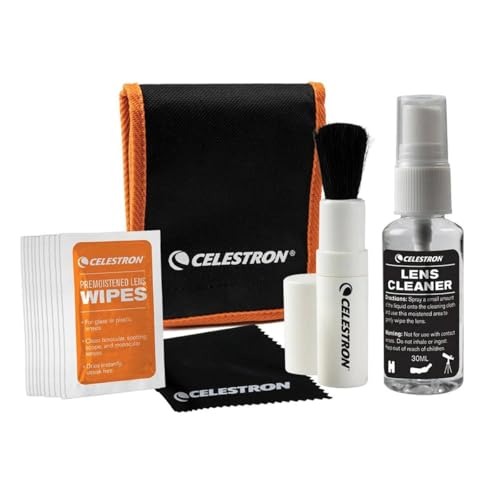
- model 93576-CGL, lens cleaning solution in a spray bottle, 10 individually wrapped pre-moistened single-use lens wipes, non-abrasive microfiber cloth, retractable cleaning brush, carrying case with belt loop, UPC 050234935760.
Celestron comes at cleaning from the optics side rather than the sensor side. This kit contains no sensor swabs at all, and that is the point: it is a lens and eyepiece kit for owners who blow dust off the sensor area but send the camera away for any wet sensor work. The manual also warns against using the contents on telescope mirrors or on contact lenses.
The contents suit field use. Ten pre-moistened wipes are individually wrapped, so a clean wipe is available at a dark-sky site or a sideline without carrying a fluid bottle for every job, and the spray bottle of cleaning solution covers heavier smudges back at home with the microfiber cloth. A retractable brush handles loose particles first, and the case has a belt loop for carrying.
Photographers whose only optics are camera lenses still get full value here, since the tools work on any coated glass, including binoculars and spotting scopes. Anyone who does plan to wet-clean a sensor, though, needs to pair this kit with a separate swab set sized to their camera.
How to choose
Start with swab width, because it is the one part that cannot be improvised. APS-C sensors take 16mm swabs and full-frame sensors take 24mm swabs, and a swab that is too wide folds at the edges while one that is too narrow needs overlapping passes. If a household runs both formats, a mixed kit avoids buying two separate sets.
Next, check the dry tools. Every routine should begin with a hand blower, since air removes grit that a cloth would drag across a coating. A lens pen and a soft brush cover most daily work, and propellant-based canned air is best kept away from a sensor chamber, where it can spray residue; a squeeze blower cannot.
Then look at consumables and storage. Count the swabs and wipes, note whether lens fluid and sensor fluid are separate bottles, and confirm how the fluid is applied: the safer pattern is fluid on the cloth or swab, never sprayed straight onto glass. A case or bag keeps clean tools clean, and individually packed cloths and swabs stay that way longest.
Who should skip
Skip these kits if your camera has a fixed lens and a sealed body, because there is no sensor to swab and a blower plus a cloth covers everything. Skip the sensor sections entirely, and pay for a service-center clean instead, if opening the shutter for cleaning makes you nervous; a damaged sensor costs far more than a professional clean.
Also skip a full kit if you only need one tool. Owners who just fight fingerprints need a pen and cloths, not ten swabs, and heavy sensor users may do better buying a basic kit for the tools and bulk swab packs for the consumable they actually burn through.
FAQ
Can a full-frame swab be used on an APS-C sensor?
No. A 24mm swab is wider than an APS-C sensor, so its edges fold and press unevenly, which can leave streaks or push debris into the corners. Match the swab to the sensor: 16mm for APS-C and 24mm for full-frame. Mixed kits exist precisely so owners of both formats do not have to compromise.
How often should a camera sensor be cleaned?
Only when spots actually appear in images, typically showing up in plain areas like sky at narrow apertures. Start with the camera’s own cleaning cycle and a blower, and save wet swabbing for spots that survive both. Cleaning on a fixed schedule adds risk without adding benefit, since every swab pass touches the sensor surface.
Is it safe to wet-clean a sensor at home?
It is a routine task when done with sealed, correctly sized swabs and the camera set to its manual cleaning mode with a well-charged battery, following the camera manual. The swabs in these kits are made for that job. Anyone unsure of the steps should use a service center instead of learning on an expensive body.
What order should the cleaning steps follow?
Dry before wet, and least contact before most. Blow loose dust off first, then brush, then use a pen or a cloth with fluid for smudges on the lens. Sensor swabs come last and only if spots remain. Fluid always goes onto the cloth or swab first, never sprayed directly onto glass or the sensor.
Final verdict
The KuuZuse Professional kit is the easiest recommendation for most owners because it covers lenses and both sensor sizes in one bag. Full-frame shooters who clean often should take the UES 21-in-1 for its ten swabs, APS-C shooters the Movo Deluxe Essentials, and careful handlers the glove-equipped K&F Concept kit. The Celestron kit suits owners who clean glass only and leave sensors to a service center.
Product and ASIN Reference
| Product | ASIN |
|---|---|
| KuuZuse Professional DSLR Camera Cleaning Kit | B08SL4SM69 |
| UES 21-in-1 Camera Cleaning Kit | B089QXQ6YF |
| Movo Deluxe Essentials DSLR Camera Cleaning Kit | B077YYTPFP |
| K&F Concept Professional Camera Lens Cleaning Kit | B08RJJ643Z |
| Celestron Lens Cleaning Kit | B08N5D9LXH |
More from Amazon
Programs that pair well with the guide above. Offers and eligibility are set by Amazon and may change.
A free business account with business pricing and bulk-buying tools for work, shop or home office.
Create a business accountFree shipping on eligible items, Prime Video and more. Eligible new members can start with a free trial.
Start a Prime free trialAudiobooks and podcasts to listen to on the go. Eligible new members can start with a free trial.
Try Audible freeAd-free music streaming. Eligible new subscribers can start with a free trial.
Try Music Unlimited freeAs an Amazon Associate we earn from qualifying purchases.
Write Your Review
No reviews yet. Be the first to share your experience!