

Key takeaways
- Best Overall for Lead Concerns: Brita Elite 10-Cup Pitcher, with a published 99 percent lead-reduction claim and a 120-gallon filter.
- Best Value Per Gallon: Waterdrop PT-07B 10-Cup Pitcher, with a 200-gallon filter listed and a low entry cost.
- Best Budget Brita: Brita Large 10-Cup Pitcher with the standard filter, the simplest way to improve chlorine taste.
- Best Premium Design: Waterdrop PT-72W Glass Pitcher, a 7-cup glass body for people who dislike plastic.
- Best for Big Households: Waterdrop WFD-40L Dispenser, a 35-cup countertop or fridge dispenser per the listing.
- Best Brita Dispenser: Brita X-Large 27-Cup Dispenser, built for parties, offices and families who fill glasses all day.
If you are choosing between Waterdrop and Brita, the short answer is that Brita Elite is the better-documented pick when lead reduction is your priority, while Waterdrop wins for most households on filter life and the number of pitcher shapes it offers. Brita is the familiar name with a huge range of pitchers and dispensers, and its Elite filter carries a published lead-reduction claim backed by NSF/ANSI certification. Waterdrop is the challenger that sells a longer-lasting filter, rated for roughly 200 gallons on the listings, and a wider selection of materials, including glass. Which one is right for you depends less on brand loyalty and more on what is in your tap water, how much you drink and how often you are willing to swap a cartridge.
This guide compares six real pitchers and dispensers head to head, three from each brand, and explains where each one fits. It is research-based: we read manufacturer pages, listing details, certification wording and independent coverage, and we did not personally use these products. Where a detail could not be confirmed we say “not listed” instead of guessing. If you also searched for “brita vs waterdrop water filter pitcher” or “which water pitcher filter lasts longest”, the sections below cover both questions directly.
Our top picks


As an Amazon Associate we earn from qualifying purchases at no extra cost to you.
Top Picks at a Glance
- Best Overall for Lead Concerns: Brita Elite 10-Cup Pitcher, with a published 99 percent lead-reduction claim and a 120-gallon filter.
- Best Value Per Gallon: Waterdrop PT-07B 10-Cup Pitcher, with a 200-gallon filter listed and a low entry cost.
- Best Budget Brita: Brita Large 10-Cup Pitcher with the standard filter, the simplest way to improve chlorine taste.
- Best Premium Design: Waterdrop PT-72W Glass Pitcher, a 7-cup glass body for people who dislike plastic.
- Best for Big Households: Waterdrop WFD-40L Dispenser, a 35-cup countertop or fridge dispenser per the listing.
- Best Brita Dispenser: Brita X-Large 27-Cup Dispenser, built for parties, offices and families who fill glasses all day.
Waterdrop vs Brita at a Glance: Comparison Table
| Product | Best for | Key specs | Watch for | Price tier |
|---|---|---|---|---|
| Brita Elite 10-Cup Pitcher | Lead-conscious households | 10-cup, Elite filter, 120 gallons, NSF/ANSI 42, 53 and 401 per Brita | Filter slows as it clogs; PFAS certification not listed | Mid-range |
| Brita Large 10-Cup Pitcher | Better-tasting tap water on a budget | 10-cup, standard filter, WQA and NSF/ANSI certified for chlorine taste and odor, copper, mercury, cadmium | Standard filter lasts about 40 gallons | Budget |
| Brita X-Large 27-Cup Dispenser | Families and offices | 27-cup, spigot, includes 1 filter | Large footprint in the fridge | Mid-range |
| Waterdrop PT-07B 10-Cup Pitcher | Long filter life and value | 10-cup, listed 200-gallon filter, NSF certified per listing | Check which standards apply to the exact filter | Budget |
| Waterdrop PT-72W Glass Pitcher | Plastic-averse shoppers | 7-cup glass, listed NSF/ANSI 53, 42 and 372 certified filter | Heavier and breakable | Mid-range |
| Waterdrop WFD-40L Dispenser | Heavy daily use | 35-cup capacity, listed 200-gallon filter | Needs counter or large shelf space | Mid-range |
1. Brita Elite 10-Cup Pitcher: Best Overall for Lead Concerns
Key specs
- 10-cup capacity with a flip-top lid for filling at the tap
- Elite filter, rated by Brita for about 120 gallons or roughly six months of typical use
- Brita states the filter reduces 99 percent of lead, along with chlorine taste and odor, asbestos, cadmium and microplastics
- Certified to NSF/ANSI 42, 53 and 401 according to Brita and certification databases
- Change indicator on the lid helps you remember the replacement date
Best for: households with older plumbing or a known lead concern who want a certified, mainstream pitcher.
Skip if: you want a broad PFAS claim. Brita’s own Elite page does not list PFAS reduction, and independent sources note that no standard Brita pitcher filter holds a PFAS certification.
The Elite is the pitcher to consider when the reason for buying a filter is lead rather than taste. NSF/ANSI 53 is the standard that covers health-related contaminants such as lead, and the Elite listing explicitly points to it. That does not make the pitcher a replacement for a lead-service-line fix or a certified lab report on your water, but it does give you a documented claim you can verify in the public certification database instead of relying on marketing language alone.
In everyday use the main trade-off with any dense carbon-block filter is flow rate. A filter that captures more fine particles fills the upper reservoir at a slower pace, so expect to pour, walk away and come back. If you drink a lot of water, plan a second fill ahead of dinner so the reservoir is full when you need it. The 10-cup size is a good fit for two to four people; one person drinking moderate amounts will see the filter reach its time limit before its gallon limit, so follow the date on the indicator.
The six-month life is a quiet advantage. Fewer swaps means fewer decisions, and for people who forget maintenance a longer cycle is more forgiving. Still, a filter past its limit stops protecting you, so set a calendar reminder for the day you install it.
Pros
- Published lead-reduction claim with NSF/ANSI 53 certification
- 120-gallon filter life
- Wide availability of replacement filters
- Familiar design that fits standard fridge shelves
Cons
- Slower pour-through than a standard filter
- No PFAS certification listed
- Replacement filters cost more per unit than the standard version
2. Waterdrop PT-07B 10-Cup Pitcher: Best Value Per Gallon
Key specs
- 10-cup capacity in a blue plastic body
- Listed as NSF certified with a 200-gallon, long-life filter
- A multi-filter version of the same pitcher is also listed with a 600-gallon total supply
- The listing says it improves the taste of coffee and tea by reducing chlorine
- Uses Waterdrop’s own filter design, so do not assume Brita cartridges will fit
Best for: shoppers who want the lowest cost of ownership over a year and are comfortable with a less familiar brand.
Skip if: you need a specific certified lead claim and cannot confirm it for the exact filter you are buying.
Waterdrop’s pitch is simple: a filter that lasts longer than a standard Brita cartridge. At a listed 200 gallons, a PT-07B filter is meant to run about as long as five standard Brita cartridges, and the maker presents that as fewer purchases over a year. The arithmetic is sensible. If your household drinks one gallon a day of filtered water, a 200-gallon filter spans a bit more than half a year on paper, though the maker’s own guidance suggests changing it on a time schedule as well.
The caveat is certification detail. The listing says NSF certified, but the standard that applies depends on the exact filter model. Independent comparison sites note that a Waterdrop filter can be certified under NSF/ANSI 42 and 372 without being certified under 53 for lead reduction. NSF 42 covers aesthetic claims such as chlorine, and 372 covers lead-free materials. Before buying for lead, open the performance data sheet for the specific filter and read which contaminants appear on it.
For taste, the pitch is easier to accept. A carbon-based filter is the right tool for chlorine taste, and the PT-07B is priced to make that change affordable. The pitcher body is light, the lid is functional rather than fancy, and it is the kind of product that makes sense as a first filter or a second pitcher for the office fridge.
Pros
- Listed 200-gallon filter life
- Low entry cost
- Multi-filter bundle available
- Light, simple design
Cons
- Certification scope varies by filter model
- Filters are not cross-compatible with Brita
- Less retail presence if you need a filter quickly
3. Brita Large 10-Cup Pitcher: Best Budget Brita
Key specs
- 10-cup capacity with one standard filter included
- WQA and NSF/ANSI certified according to the listing for chlorine taste and odor, copper, mercury and cadmium
- Standard filter is rated for about 40 gallons, roughly two months
- Available in several colors; a SmartLight version adds an electronic change indicator
Best for: first-time filter buyers who only want to remove the chlorine taste from city water.
Skip if: your priority is lead, since the standard filter is not the one Brita markets for that job.
This is the pitcher most people picture when they hear the word Brita. It is inexpensive, available almost everywhere, and replacement filters are easy to find. The standard filter does what most shoppers need: it cuts the chlorine taste and smell that make tap water unpleasant, and it addresses a short list of metals. For many households on a municipal supply that is the entire goal.
The cost is in the frequency. A 40-gallon rating means a two-month change cycle, so you will buy about six filters a year, usually in multi-packs. Over time that makes the standard Brita more expensive to run than a longer-life filter, which is why value hunters often step up to the Elite or move to Waterdrop. If you drink less water, the two-month limit still applies, because the filter is rated by time as well as volume.
If you like to be told when to change the filter, the SmartLight version adds a lid indicator that flashes when it is due. It is a small feature that removes guesswork and can be worth the small extra spend for forgetful households.
Pros
- Lowest upfront cost of the Brita options
- Standard filters sold nearly everywhere
- Fast pour-through
- Colors and indicator options
Cons
- Two-month filter cycle
- Not the lead-focused filter
- Plastic body can scratch over time
4. Waterdrop PT-72W Glass Pitcher: Best Premium Design
Key specs
- 7-cup glass body with a white lid, marketed as eco-friendly
- Listing states an NSF/ANSI 53, 42 and 372 certified filter
- Larger sibling, the PT-09W, offers a 10-cup glass option per the listing
- Glass avoids the plastic taste some people notice in new pitchers
Best for: buyers who want a counter-worthy pitcher and prefer to avoid plastic contact with their drinking water.
Skip if: you have small children, a crowded fridge door or a history of dropping dishes.
The glass pitcher is the most design-driven product in this comparison. It looks better on a table, keeps flavors neutral and feels sturdy in the hand. The listing is also the only Waterdrop pitcher here that names NSF/ANSI 53 alongside 42 and 372, which suggests the filter used with it is certified for health-related reductions as well as taste. As always, confirm the claim on the data sheet for the exact filter before you rely on it.
The compromise is capacity and weight. Seven cups disappears quickly with more than two people, and glass makes a full pitcher heavy to lift with one hand. The lid design matters here too, because a poorly seated lid on a glass body is an easy spill. If you will mostly use it for yourself or a couple, it is a pleasant upgrade; for a family, pair it with a bigger dispenser.
The other factor is storage. Glass is not usually designed for the fridge door, so check shelf height before you buy and measure the fridge shelf where it will live.
Pros
- Glass body with no plastic contact on the water reservoir
- Listing names NSF/ANSI 53, 42 and 372
- Attractive enough for the table
- Easy to clean
Cons
- Smaller 7-cup capacity
- Heavier and breakable
- Higher cost than plastic Waterdrop models
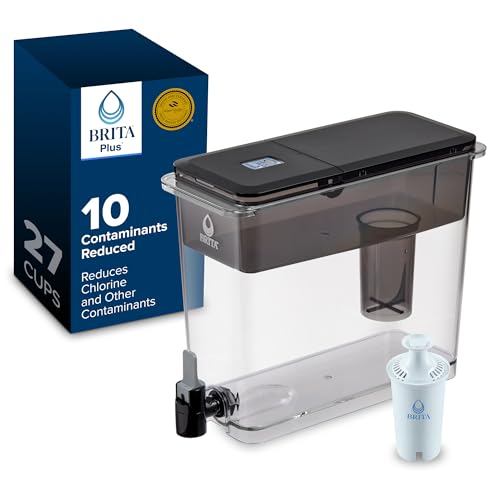
5. Brita X-Large 27-Cup Dispenser: Best Brita for Big Households
Key specs
- 27-cup capacity with a front spigot
- Includes one filter, WQA and NSF/ANSI certified per the listing
- Available in black and gray; an Ultramax version with an Elite filter is also listed
- Filter swaps follow the same schedule as the pitchers
Best for: families, shared offices and anyone who is tired of refilling a pitcher several times a day.
Skip if: your fridge shelves are shallow or you only drink a couple of glasses a day.
A dispenser changes how you use filtered water. Because the reservoir is larger, you fill it less often, and the spigot makes it easy for kids to help themselves. Many people find that they drink more water simply because it is within easy reach. The trade-off is space: a 27-cup unit takes real room in the fridge, and many people leave it on the counter instead, where warm water is less appealing.
The version that includes the standard filter is the budget route. If lead is a concern, look for the version listed with an Elite filter and confirm the certification details on the page. The dispenser’s filter is the same family as the pitcher filters, so you can stock a single type of replacement across both products if you own more than one Brita.
Keep it clean. Large reservoirs can develop film if they are not washed regularly, so empty and rinse it each time you change the filter.
Pros
- Large capacity cuts refills
- Spigot for easy pouring
- Uses familiar Brita filters
- Elite filter version available
Cons
- Takes significant fridge or counter space
- Heavy when full
- Slow to refill through the top
6. Waterdrop WFD-40L Dispenser: Best for Heavy Daily Use
Key specs
- 35-cup capacity per the listing
- Black body, listed with a 200-gallon long-life filter
- An alkaline variant (WFD-40L-A) is also sold; this is a taste preference, not a health claim
- Larger WFD-22L model is listed at 40 cups
Best for: big households that want long filter life and a huge reservoir.
Skip if: you need a compact appliance or have to confirm a specific certification before buying.
The WFD-40L is Waterdrop’s answer to the large Brita dispenser, and it leans on the same selling points as the pitchers: long filter life and generous capacity. For a family that goes through many glasses a day, a 200-gallon filter in a 35-cup tank is a convenient combination, because you spend less time on both refills and swaps.
As with the pitchers, treat certification as something to check, not assume. Read the product page and the performance data sheet to confirm what the filter reduces. If you want an alkaline variant for taste, understand that it is a flavor preference and that the listing’s pH claims should not be read as health advice.
Because the dispenser is large, think about where it will sit. A unit this size works best on a counter or a deep refrigerator shelf, and you should always keep it out of direct sunlight.
Pros
- Large capacity with long filter life
- Alkaline variant available for those who want it
- Good fit for families and offices
Cons
- Bulky footprint
- Certification scope needs checking
- Heavy when full
Also Consider
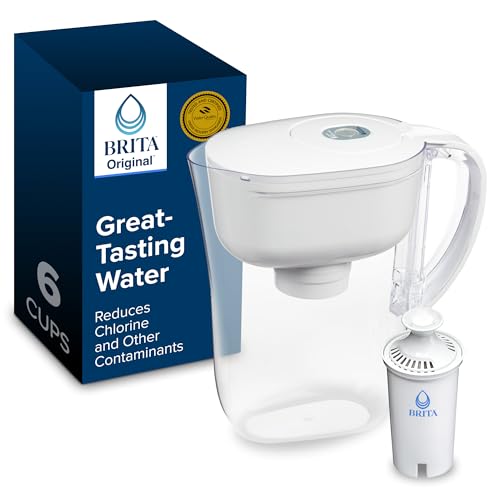
Brita Small 6-Cup Pitcher
A compact pitcher that fits in a mini fridge or dorm. It uses the standard Brita filter and is listed as WQA and NSF/ANSI certified for chlorine, copper and other aesthetic items.
Waterdrop PT-05B-L 7-Cup Pitcher
A smaller, lower-cost Waterdrop pitcher with the same listed 200-gallon filter. A good second pitcher for a desk or small home.
PUR 11-Cup Water Pitcher
A mainstream alternative with a well-known filter line. Check the filter version listed to see whether it includes a lead-reduction claim.
ZeroWater 10-Cup Pitcher
A five-stage filter pitcher that lists IAPMO certification for lead, PFOA/PFOS, chromium and mercury. It is a different design with a total dissolved solids meter, so it suits people who want more than a taste upgrade.
How We Chose
This guide is research-based. We did not personally use these products. We read the listing details for every pitcher named above, compared them with manufacturer pages for Brita and Waterdrop, and looked at independent comparisons that explain what each NSF/ANSI standard actually covers. We favored products that were clearly on sale from a named maker, had a stated capacity and filter life, and had a certification claim we could trace to a standard number.
We included three products per brand so the comparison stays fair. For each pitcher we asked: how big is it, how long does the filter last, which contaminants does the maker say it addresses, and is that claim attached to a recognized certification? We also noted where information was missing, such as PFAS claims for Brita and the exact standard for each Waterdrop filter, instead of filling in gaps. Independent coverage consistently says that the Brita Elite is better documented for lead and that Waterdrop offers a lower cost per gallon, which matches what the listings show.
Buying Guide
Decide what you want the filter to do
Filters do different jobs. Chlorine taste and odor are aesthetic claims, usually covered by NSF/ANSI 42. Lead and other health-related contaminants are covered by NSF/ANSI 53. Microplastics are covered under NSF/ANSI 401 for emerging contaminants. If you only care about taste, a standard filter is enough. If your concern is lead, look for a model whose listing and data sheet name NSF/ANSI 53 and lead specifically. If your concern is PFAS, neither brand’s popular pitcher filters make a clearly certified claim in the sources we reviewed, so look at products that list a PFAS standard explicitly. If you have a health concern about your water, ask your water utility for its latest report or a certified lab for a water report.
Check the filter life, not just the pitcher price
The pitcher is a one-time purchase, but the filter is a recurring cost. A standard Brita filter at about 40 gallons or two months means roughly six filters a year. A Brita Elite at 120 gallons or six months means about two. A Waterdrop filter at a listed 200 gallons means about two or three, depending on how closely you follow the maker’s time guidance. Add up a full year of filters before comparing prices, and compare the cost per gallon as well as the cost per cartridge.
Pick a size that matches how many people drink from it
A 6-cup or 7-cup pitcher suits one or two people. A 10-cup is the sweet spot for a small family. Anything above 20 cups is a dispenser and belongs on a counter or a large fridge shelf. Remember that dense filters pour slowly, so a pitcher that is too small will often be empty when you want a glass.
Think about material and cleaning
Plastic is light, cheap and shatter-resistant, which suits kids and fridge doors. Glass looks better and avoids plastic contact but is heavier and breakable. Whichever you choose, wash the pitcher and lid by hand on a regular schedule, and rinse the reservoir whenever you change the filter. Check the manufacturer’s advice before using a dishwasher.
Confirm filter compatibility before buying spares
Brita pitchers and dispensers share a filter family, so one box of replacements usually covers several models. Waterdrop uses its own filter designs, so buy spares from the same listing family and confirm that the model number matches your pitcher. Third-party filters sold as compatible may not carry the same certification, so check the claim before relying on it.
Common Mistakes to Avoid
- Assuming every filter removes lead. Only filters whose data sheets list lead reduction under NSF/ANSI 53 make that claim.
- Ignoring the time limit. A filter should be replaced by date even when the gallon count has not been reached.
- Buying generic filters without checking certification wording.
- Leaving water standing in a warm room. Keep the pitcher refrigerated and rinse it regularly.
- Skipping the first rinse. New filters usually need a short flush before first use; follow the included instructions.
Frequently Asked Questions
Is Waterdrop better than Brita?
Waterdrop is better on listed filter life and cost per gallon, while Brita is better on retail availability and documented lead certification in the Elite model. Neither is universally better; it depends on whether your priority is value or a clearly certified lead claim.
Which lasts longer, a Waterdrop or a Brita filter?
A Waterdrop filter is listed at about 200 gallons, compared with 40 gallons for a Brita standard filter and 120 gallons for a Brita Elite. Both brands also recommend replacing filters on a time schedule.
Do Waterdrop filters fit Brita pitchers?
No, you should not assume they do. Waterdrop uses its own filter designs and Brita uses its own, so buy replacements matched to your pitcher model and check the listing for compatibility.
Do Brita or Waterdrop pitchers remove PFAS?
Neither brand clearly lists a PFAS certification for its mainstream pitcher filters in the sources we reviewed. If PFAS is your main concern, look for a filter whose data sheet names a PFAS standard explicitly, and consider a different product type.
Which is better for lead, Brita Elite or Waterdrop?
Brita Elite has the clearer public claim, a 99 percent lead reduction statement with NSF/ANSI 53 certification. Some Waterdrop filters also list NSF/ANSI 53, but the scope varies by model, so verify the exact filter on its data sheet.
How often should I change a pitcher filter?
Follow the maker’s guidance: about every two months for a standard Brita, about six months for a Brita Elite, and the interval on the Waterdrop listing for its filter. Change earlier if flow slows sharply or the taste changes.
Is a glass pitcher worth it?
It is worth it if you prefer to avoid plastic and value looks, but you accept a smaller, heavier and more fragile pitcher. For busy families a plastic pitcher is usually more practical.
Which One Should You Buy?
If lead is your main concern, buy the Brita Elite 10-Cup Pitcher and confirm the certification on the Brita product page. If you want the lowest running cost and mostly care about taste, buy the Waterdrop PT-07B and check its data sheet. If you are on a tight budget or want the easiest filters to find, the Brita Large 10-Cup is a safe starting point. If you hate plastic, the Waterdrop PT-72W Glass Pitcher is the stylish choice. For big households, choose between the Brita X-Large 27-Cup Dispenser and the Waterdrop WFD-40L Dispenser based on whether you prefer familiar filters or a longer filter life.
Whichever you pick, set a reminder for the first filter change, rinse the pitcher regularly and keep your expectations realistic: a pitcher filter improves taste and addresses specific listed contaminants, but it is not a complete treatment system. If you have serious concerns about your water, speak to your water utility or a qualified professional.
Sources
- Brita product pages for the Elite and standard filters
- Waterdrop product pages and performance data sheets for the PT-07B, PT-72W and WFD-40L
- NSF International certification listings and standard descriptions for NSF/ANSI 42, 53, 372 and 401
- OffGrid Filters comparison of Waterdrop Plus and Brita Elite
- FilterPicks comparison of Waterdrop and Brita
Last updated: October 2026


Write Your Review
No reviews yet. Be the first to share your experience!