

Our Short List of 3

All 5 Picks at a Glance
| Product | Specs | Action |
|---|---|---|
| HiCoup Kitchenware Wine Opener, Professional Corkscrew, Classic Rosewood | Check price on Amazon | |
 OXO SteeL Winged Corkscrew with Removable Foil Cutter | Check price on Amazon | |
| Rabbit W6004N Original Lever Corkscrew Wine Opener with Foil Cutter and Extra Spiral, Black Finish | Check price on Amazon | |
 Secura Electric Wine Opener, Automatic Electric Wine Bottle Corkscrew Opener with Foil Cutter, Rechargeable (Stainless Steel) | Check price on Amazon | |
 Monopol Westmark Germany Steel Two-Prong Cork Puller with Cover (Silver Satin) | Check price on Amazon |
Key takeaways
- Compare five wine openers for home use, from a classic waiter's corkscrew to an electric model, and find the smoothest way to open every bottle.
Opening a bottle of wine should feel calm, not like a small wrestling match at the kitchen counter. A cork that snaps halfway out, crumbs floating in the glass, or a worm that wanders off center can turn a quiet evening into a fiddly cleanup job. The right opener avoids all of that by centering its worm, pulling straight upward, and matching the cork in front of it, whether that cork is firm, dense and synthetic, or fragile and aged.
The five openers below cover the main ways to get a cork out: a classic folding waiter’s key, a familiar winged corkscrew, a lever model that does the heavy work for you, an electric opener that removes effort almost entirely, and a two-prong puller that never pierces the cork at all. Each one suits a different kind of drinker, a different grip, and a different bottle rack, so the best choice depends on how often you open wine, how strong your hands are, and what kinds of corks your bottles carry.
As an Amazon Associate, we earn from qualifying purchases.
Quick answer
Start with the HiCoup rosewood waiter’s key if you open wine most weeks: its two-step fulcrum pulls corks straight and it stores in a drawer. Choose the Rabbit lever or the Secura electric when grip strength is limited, the OXO winged model for the simplest mechanism, and the Monopol two-prong puller for old, fragile corks.
HiCoup Kitchenware Wine Opener, Professional Corkscrew, Classic Rosewood
The HiCoup Kitchenware Wine Opener is a waiter’s key, the folding design servers carry because it handles every part of the job in one pocket-sized tool. A stainless steel worm folds out of the rosewood handle alongside a curved, serrated foil cutter and a cap remover, so one key opens both the bottle for dinner and a capped soda.
Its working advantage is the double-hinged, two-step fulcrum. You seat the first step on the lip of the bottle and lift until the cork rises partway, then switch to the second step and finish the pull. Two shorter lifts keep the pull vertical, which is what stops long or dry corks snapping halfway out.
The rosewood handle is warm, rounded, and easy to grip. The trade-offs are honest ones: a short learning curve, a foil knife that needs a firm draw, and two hands on the bottle while you work. Learn it once, though, and this opener covers the most bottles for the longest time, from everyday natural corks to dense synthetic ones, without batteries, moving parts, or bulk.
OXO SteeL Winged Corkscrew with Removable Foil Cutter
The OXO SteeL Winged Corkscrew is the design most people already know: place it over the cork, turn the top knob to drive the worm down, then press the two raised wings to lever the cork out. OXO’s version, model 1058011, earns its place because its details are better sorted than the generic winged openers that bend, wobble, and shred corks.
The screw is non-stick and self-centering. A winged opener lives or dies by whether the worm enters the center of the cork, and the self-centering point and extended body keep the pull straight, so corks come out whole instead of breaking. The curved wings are die-cast and wide enough to spread pressure across your palms, and the soft, non-slip turning knob stays grippy while you twist.
A removable foil cutter snaps into the base for storage. The honest limits are size and effort: winged openers demand a firm two-handed squeeze, the mechanism is bulky next to a folding key, and a winged worm is the wrong tool for a fragile, decades-old cork, which deserves the two-prong puller below.
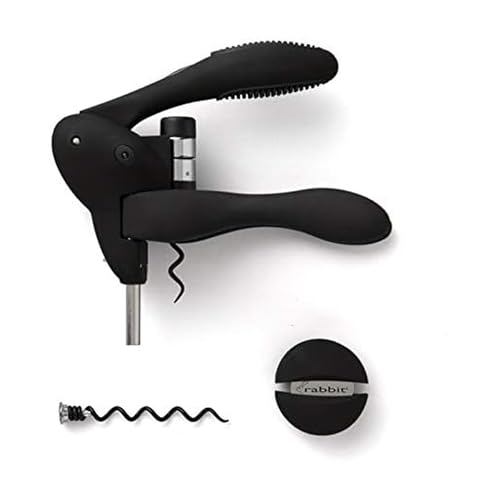
Rabbit W6004N Original Lever Corkscrew Wine Opener with Foil Cutter and Extra Spiral, Black Finish
The Rabbit Original Lever Corkscrew replaces technique with leverage. Squeeze the handles around the bottle neck, push the lever down to drive the worm in, then pull it back up and the cork comes out with it, a motion the maker times at about three seconds. A second push ejects the cork from the spiral, so nobody wrestles a stuck cork while guests wait for a pour.
That mechanical help earns a lever model its shelf space for hosts opening several bottles across a long evening and for anyone whose grip makes a waiter’s key hard work. It grips and releases natural, synthetic, and plastic corks alike, and the construction mixes hardened polycarbonate, metal, and reinforced nylon around a non-stick coated spiral. The spiral is rated for twenty thousand pulls, a spare is included, and a ten-year warranty stands behind the tool.
The compromises are size and moving parts. A lever corkscrew is a countertop object, not a drawer tool, and when a spiral dulls, the opener is only as good as its replacement. Open a bottle a month and it is more machine than the household needs; open bottles for guests every weekend and it earns its place.
Secura Electric Wine Opener, Automatic Electric Wine Bottle Corkscrew Opener with Foil Cutter, Rechargeable (Stainless Steel)
The Secura Electric Wine Opener removes the effort question entirely. Set it squarely on the bottle, hold the bottle steady, and press the lower button: the motor drives the worm in and draws the cork out, lit by a soft blue light, and the upper button ejects the cork. For someone with arthritis or weak wrists, that routine is the difference between opening a bottle independently and asking for help.
The housing is stainless steel with a transparent shell around the mechanism, so you can watch the worm stay centered as it works. The built-in battery is rechargeable and rated to open up to thirty bottles on a single charge, and the charger’s wide 100-240V input suits households that travel. A foil cutter is included, so the kit covers the full job from foil to pour.
Electric openers have two honest weaknesses. The battery is a consumable: the maker advises recharging every three months even when the opener sits unused, and a neglected battery is the usual reason one fades after a year or two. The motor can also strain on dense synthetic corks. Keep it charged and it is the easiest opener here.
Monopol Westmark Germany Steel Two-Prong Cork Puller with Cover (Silver Satin)
The Monopol Ah-So, made in Germany by Westmark, opens wine without piercing the cork at all. Two thin, hardened steel prongs slide down between the cork and the inside of the bottle neck, longer prong first, worked in with gentle rocking. Once the prongs grip the sides of the cork, a slow twist while pulling draws it out whole and unholed, which is why this design is the traditional answer for aged bottles whose corks have gone soft or crumbly.
Because nothing punctures the cork, it can be pushed back in to reseal an unfinished bottle, and no worm tears a fragile cork apart from inside. The die-cast handle doubles as a crown cap opener, and the prongs travel in a protective cover. Keep them dry and stored in that cover to keep them true.
This is a specialist, not an all-rounder. There is a real learning curve: rock the prongs in patiently, or a loose cork gets pushed into the bottle instead of lifted out. It is also slower than every other opener here on a young, firm cork. Keep it as the second opener in a household that holds the occasional older bottle.
How to choose
Start with your hands. A waiter’s key rewards a little practice with the most control and the smallest footprint. A winged corkscrew needs no learning, just a firm squeeze. Lever and electric models trade shelf space for the least physical effort.
Next, look at the worm. You want an open helix, a long spiral with space between the turns, and a sharp point that sits dead center. Tight, closed coils and off-center tips tear corks apart. A non-stick coating helps the worm release cleanly, and on lever models a replaceable spiral matters, since the spiral is what wears out first.
Then match the opener to your corks: synthetic corks reward leverage or a motor, while old natural corks call for prongs or a gentle two-step pull. None of these should be used on sparkling wine, where the cork is already under pressure.
Who should skip
Skip this category almost entirely if your drinks are mostly screw-cap wines, canned drinks, and bottled sodas; the corkscrew will sit in a drawer while bottles twist or pop open by hand. Also skip these five if you mainly open prosecco and other sparkling wines, since any corkscrew is the wrong, unsafe tool for a pressurized cork. And if you open a bottle only a few times a year, buy the winged model and stop there: lever mechanisms and rechargeable batteries age worse in a drawer than a plain folding key.
Frequently asked questions
What is the easiest type of wine opener for a beginner?
A winged corkscrew or an electric opener asks the least of a first-time user. The winged design is self-explanatory: twist the knob, push the wings down, and the OXO above adds a self-centering screw that forgives imperfect aim. An electric model reduces the job to holding the bottle steady and pressing a button.
Can these openers handle synthetic corks?
Yes. Synthetic corks are denser and slicker than natural cork, so they reward leverage: the Rabbit lever and the Secura electric pull them without hand strength, and a waiter’s key with an open-helix worm handles them well once the tip is centered. The two-prong puller is the exception, since its prongs can slip on smooth synthetics, so save it for natural corks.
How do I open an old bottle with a crumbling cork?
Reach for the two-prong puller. Work the longer prong down between cork and glass first, then the shorter one, rocking gently rather than forcing, until both prongs hug the cork. Twist slowly as you pull upward and the cork usually emerges in one piece. If crumbs still shed, pour the first glass through a fine strainer.
Can I use a corkscrew on Champagne or prosecco?
No. Sparkling wine corks are held in by pressure inside the bottle, and driving a worm into one is dangerous. The correct method uses no tool: keep a thumb on the cork while you remove the foil and wire cage, cover it with a towel, hold the cork still, and twist the bottle from its base until the cork eases out.
Final verdict
For most households, the HiCoup rosewood key is the buy once, use for years answer: compact enough for a drawer, at home with natural and synthetic corks, and gentler on older corks than any single-pull design. Choose the OXO winged model for the simplest mechanism a guest can work out alone, the Rabbit lever or Secura electric if effort is the obstacle, and add the Monopol two-prong puller once the rack holds bottles with fragile corks.
Product and ASIN Reference
| Product | ASIN |
|---|---|
| HiCoup Kitchenware Wine Opener, Professional Corkscrew, Classic Rosewood | B00MSXW15E |
| OXO SteeL Winged Corkscrew with Removable Foil Cutter | B000FEF9LQ |
| Rabbit W6004N Original Lever Corkscrew Wine Opener with Foil Cutter and Extra Spiral, Black Finish | B00004SQ0K |
| Secura Electric Wine Opener, Automatic Electric Wine Bottle Corkscrew Opener with Foil Cutter, Rechargeable (Stainless Steel) | B01261VEOG |
| Monopol Westmark Germany Steel Two-Prong Cork Puller with Cover (Silver Satin) | B0002WZR4K |
More from Amazon
Programs that pair well with the guide above. Offers and eligibility are set by Amazon and may change.
A free business account with business pricing and bulk-buying tools for work, shop or home office.
Create a business accountFree shipping on eligible items, Prime Video and more. Eligible new members can start with a free trial.
Start a Prime free trialAudiobooks and podcasts to listen to on the go. Eligible new members can start with a free trial.
Try Audible freeAd-free music streaming. Eligible new subscribers can start with a free trial.
Try Music Unlimited freeAs an Amazon Associate we earn from qualifying purchases.
Write Your Review
No reviews yet. Be the first to share your experience!