

Our Short List of 3
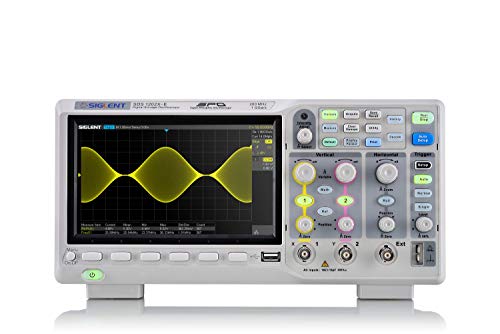
- Best for: A first bench scope for two-channel embedded serial work.
- Bandwidth: 200 MHz
- Channels: 2
- Sample rate: 1 GSa/s (500 MSa/s per channel with both channels on)
- Record length: 14 Mpts
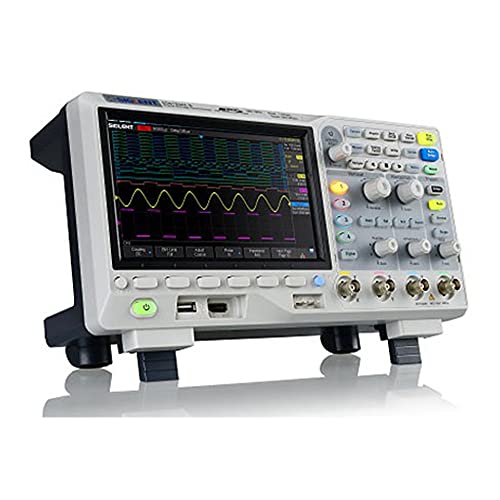
- Best for: Debugging multi-signal boards today, with a logic-analyser upgrade available later.
- Bandwidth: 100 MHz
- Channels: 4
- Sample rate: 1 GSa/s
- Record length: 14 Mpts

- Best for: Fine signal detail and portability on a compact bench.
- Bandwidth: 70 MHz
- Channels: 4
- Vertical resolution: 12-bit
- Sample rate: 1.25 GSa/s (312.5 MSa/s with all four channels on)
All 3 Picks at a Glance
| Product | Specs | Action |
|---|---|---|
| Siglent SDS1202X-E |
| Check price on Amazon |
| Siglent SDS1104X-E |
| Check price on Amazon |
| Rigol DHO804 |
| Check price on Amazon |
Key takeaways
- Compare three digital storage oscilloscopes with serial decoding included as standard, and check bandwidth, channels and memory before you buy.
Buying a bench oscilloscope for embedded work is really two decisions in one. You need enough bandwidth and memory to see your signals cleanly, and you need the scope to trigger on and decode the serial buses on your boards without a paid software unlock waiting for you later. Many models advertise protocol analysis while treating decoding as an optional extra, so the listing wording matters more than the headline bandwidth figure.
The three scopes below were chosen because their own Amazon listings state serial bus triggering and decoding as standard equipment. A two-channel Siglent suits a first serious bench, the four-channel Siglent adds room for an optional logic upgrade, and the Rigol brings 12-bit resolution and USB-C power to a compact desk. Each fits a different bench, so match the decoder list and channel count to your boards first.
Quick Picks
As an Amazon Associate we earn from qualifying purchases.
| Product | Best for | Key spec from title |
|---|---|---|
| Siglent SDS1202X-E | A first bench scope for two-channel serial work | 200 MHz, 2 channels, standard decoder |
| Siglent SDS1104X-E | Four channels with an optional logic upgrade path | 100 MHz, 4 channels, standard decoder |
| Rigol DHO804 | Fine signal detail on a small, portable bench | 70 MHz, 4 channels, 12-bit resolution |
How to Choose
Confirm Decoding Is Included, Not an Extra
Serial decoding is the whole point of this shortlist, so check how each listing phrases it before anything else. On all three scopes here, the product name or listing states standard decoding, which means the protocol triggers and decoders are part of the instrument rather than a licence you buy afterwards. Read the decoder list itself, not just the headline: one scope may cover I2C, SPI, UART, CAN and LIN, while another covers a different set. If your project depends on one specific bus, that single line in the listing decides whether the scope works for you at all.
Count the Channels Your Debugging Actually Needs
Two channels are enough when you probe one clock line against one data line, which covers a large share of I2C and SPI fault-finding. Four channels earn their space when you want to watch a bus alongside the analogue signals around it, such as a sensor output and a power rail during the same fault. Think about the last three debugging sessions you ran and count how often a third probe would have saved a second capture. If the answer is often, start with four channels rather than planning to replace the scope within a year.
Leave Headroom in Bandwidth, Rate and Memory
Bandwidth sets the fastest edge the scope shows faithfully, while sample rate and record length decide how much of a long serial packet you capture at full detail. Note how the figures change with channels in use: the two-channel Siglent samples at 1 GSa/s but drops to 500 MSa/s per channel with both channels running, and the Rigol’s 25 Mpts memory falls to 5 Mpts with all four channels on. For slow serial buses these numbers are comfortable, but headroom is what keeps the same scope useful when you move to faster signals later.
Weigh Capture Rate, Screen and Connections
A fast waveform capture rate helps you catch the intermittent glitch that only appears once in a thousand packets, which is often the exact fault a serial decoder is meant to expose. Screen size and resolution then decide how readable a decoded packet table is during a long session: the Rigol’s 7-inch 1024×600 capacitive touchscreen and HDMI output suit a small desk or a shared monitor, while the Siglent models use a 7-inch 800×480 display. Finally, check how the scope is powered and connected, since USB-C power on the Rigol makes it easy to run away from a fixed bench supply.
The 3 Best Options
Siglent SDS1202X-E
- Best for: A first bench scope for two-channel embedded serial work.
- Bandwidth: 200 MHz
- Channels: 2
- Sample rate: 1 GSa/s (500 MSa/s per channel with both channels on)
- Record length: 14 Mpts
A first bench scope for two-channel embedded serial work.
The sample rate halves per channel when both channels run, so check that 500 MSa/s per channel still suits your fastest signal.
This is the straightforward pick when two channels cover your work and you want the most bandwidth in this group. Its listing carries “Standard Decoder” in the name itself, with serial bus triggering and decoding for I2C, SPI, UART, RS232, CAN and LIN included rather than sold separately. The 200 MHz front end and 14 Mpts record length give a hobbyist or technician room to grow beyond slow buses, and the very fast capture rate helps surface rare glitches. For a first serious bench scope aimed squarely at embedded serial debugging, it is the balanced starting point here.
Siglent SDS1104X-E
- Best for: Debugging multi-signal boards today, with a logic-analyser upgrade available later.
- Bandwidth: 100 MHz
- Channels: 4
- Sample rate: 1 GSa/s
- Record length: 14 Mpts
Debugging multi-signal boards today, with a logic-analyser upgrade available later.
Make sure the listing you open is the standalone grey unit; the same model also circulates bundled with unrelated accessories, which is a different listing.
Choose this model when four channels matter more to you than raw bandwidth. It keeps the same standard serial decoding set as its two-channel sibling — I2C, SPI, UART, RS232, CAN and LIN — while doubling the analogue inputs, which makes it easier to watch a bus and the surrounding circuit behaviour in one capture. Uniquely in this group, the four-channel model also supports an optional 16 digital channel MSO upgrade and a USB AWG module, so it can grow toward mixed-signal work later. That upgrade path is what separates it from simply buying the cheaper scope twice over.
Rigol DHO804
- Best for: Fine signal detail and portability on a compact bench.
- Bandwidth: 70 MHz
- Channels: 4
- Vertical resolution: 12-bit
- Sample rate: 1.25 GSa/s (312.5 MSa/s with all four channels on)
Fine signal detail and portability on a compact bench.
Its confirmed decoder set does not include LIN, so if your work involves LIN bus traffic, pick one of the Siglent models instead.
The DHO804 takes a different route: instead of chasing bandwidth, it offers 12-bit vertical resolution, so small level changes on a signal are resolved more finely than on a standard 8-bit front end. Serial decoding is included as standard for RS232/UART, I2C, SPI, CAN and parallel buses, and the UltraAcquire mode pushes capture rates up to 1,000,000 waveforms per second for hunting rare events. Its 7-inch capacitive touchscreen, HDMI output and USB-C power make it the easiest of the three to run on a cramped desk, in a classroom or away from your main bench.
Which One Fits Your Situation
You Are Setting Up a First Embedded Bench
Start with the Siglent SDS1202X-E. Two channels handle the classic clock-versus-data probing that most I2C and SPI debugging involves, its 200 MHz bandwidth is the highest here, and the standard decoder covers six bus types including CAN and LIN. It leaves you the fewest reasons to replace the scope as your projects grow.
You Debug Boards With Several Signals at Once
The Siglent SDS1104X-E fits when you routinely watch a serial bus alongside sensor outputs or power rails. Four channels capture the whole scene in one pass, and the optional 16-channel MSO upgrade gives the scope a future step into mixed-signal work that neither of the other two models offers in this form.
Your Bench Is Small or You Work in More Than One Place
Pick the Rigol DHO804. USB-C power, a compact touchscreen body and an HDMI output make it easy to move between a desk, a lab and a classroom, while 12-bit resolution shows small signal steps clearly. Just confirm your buses are among UART, I2C, SPI, CAN or parallel before choosing it.
Your Projects Include Automotive CAN and LIN Networks
Choose either Siglent, since both listings state CAN and LIN decoding as standard. The SDS1202X-E suits two-channel network probing with more bandwidth in reserve; the SDS1104X-E suits sessions where you also want extra channels on related signals. The Rigol’s confirmed decoder set covers CAN but not LIN, so it is the wrong pick for LIN work.
Common Mistakes
- Assuming every scope with “protocol analysis” in its description includes the decoders, when on many models they are paid options rather than standard equipment.
- Checking that a scope decodes “serial buses” in general instead of confirming your exact bus, such as LIN, appears in that model’s own decoder list.
- Buying a bundle listing of the right scope paired with unrelated accessories, then comparing it against the standalone unit as if they were the same offer.
- Reading the headline sample rate and memory depth without checking the reduced per-channel figures that apply when every channel is switched on.
- Choosing two channels to save money, then discovering your debugging style needs a bus and two analogue signals captured at the same moment.
Frequently Asked Questions
Is serial decoding really included on these scopes, or will I pay extra later?
On all three models here, the listings state serial triggering and decoding as standard equipment, so the decoders named for each scope are part of the instrument as sold. That is the key distinction from scopes where protocol packages are licensed options. Always re-read the decoder list on the exact listing before ordering, because the set of buses differs between models.
Which of these scopes can decode a LIN bus?
Both Siglent models list LIN among their standard decoders, alongside I2C, SPI, UART, RS232 and CAN. The Rigol DHO804’s confirmed decoder set covers RS232/UART, I2C, SPI, CAN and parallel, with no LIN included. If LIN traffic is part of your work, that single difference should steer you to a Siglent regardless of the other specifications.
Is 70 MHz bandwidth enough for I2C, SPI and UART debugging?
For the buses themselves, yes: these serial links run far below the bandwidth of any scope here, and decoding depends on clean edges and triggering rather than raw megahertz. The Rigol’s limits appear with faster analogue signals and with all four channels running, when its sample rate and memory depth fall. If you also probe fast switching circuits, the 200 MHz Siglent gives more headroom.
Can I add logic-analyser channels to one of these later?
Only the four-channel Siglent SDS1104X-E lists that path: its specifications include an optional 16 digital channel MSO capability and a USB AWG module. The two-channel Siglent and the Rigol are analogue-only instruments as listed. If mixed-signal debugging is a realistic future need rather than a someday wish, that option is a genuine reason to choose the SDS1104X-E now.
More from Amazon
Programs that pair well with the guide above. Offers and eligibility are set by Amazon and may change.
A free business account with business pricing and bulk-buying tools for work, shop or home office.
Create a business accountFree shipping on eligible items, Prime Video and more. Eligible new members can start with a free trial.
Start a Prime free trialAudiobooks and podcasts to listen to on the go. Eligible new members can start with a free trial.
Try Audible freeAd-free music streaming. Eligible new subscribers can start with a free trial.
Try Music Unlimited freeAs an Amazon Associate we earn from qualifying purchases.


Write Your Review
No reviews yet. Be the first to share your experience!