

Our Short List of 3
All 5 Picks at a Glance
| Product | Specs | Action |
|---|---|---|
 Wilton CS4 Cross Slide Drill Press Vise, 4-Inch | Check price on Amazon | |
 Wilton CS6 Cross Slide Drill Press Vise, 6-Inch | Check price on Amazon | |
 WEN CV414 Cross Vise, 4.25-Inch | Check price on Amazon | |
 WEN DPA423 Drill Press Vise, 3-Inch | Check price on Amazon | |
 TEKTON 53994 Drill Press Vise, 4-Inch | Check price on Amazon |
Key takeaways
- Compare the best drill press vises for accurate, repeatable holes. Cross-slide, low-profile, compact picks with jaw sizes, travel, mounting details.
A drill press vise holds the workpiece still so the bit enters where you aimed it, hole after hole. Without one, small parts spin, flat stock creeps, and round stock rolls away from the bit. The right vise bolts to the table, grips the work squarely, and lets you reposition it in small steps for a row of holes or a tapped pattern.
As an Amazon Associate, we earn from qualifying purchases.
Quick answer
For most benchtop drill presses, the Wilton CS4 is the strongest all-round pick, with 4-inch jaws, hardened V-grooves for round stock, and 4.9 inches of travel each way. For a bigger envelope, step up to the 6-inch Wilton CS6. The WEN CV414 gives the longest slide travel, 5.8 by 6 inches. Compact presses suit the 3-inch WEN DPA423 or the plain 4-inch TEKTON 53994.
Wilton CS4 Cross Slide Drill Press Vise, 4-Inch
The Wilton CS4 is a cross-slide vise built around a fine-grain cast iron body, with 4-inch jaws that open a full 4 inches and a jaw depth of 1-3/8 inches. Two crossed slides move the workpiece 4.9 inches each way, so you can drill a row of holes or line up a tap without unclamping and re-squaring the part. Cast side knobs dial in 0.1 mm increments, which makes small moves repeatable when stepping across a bracket or plate.
The hardened V-grooved jaws hold round stock upright or on its side, which covers dowels, pipe, and rod as well as flat bar. Five bolt lugs give several ways to fix the vise to the table, and the unit weighs 20 pounds, heavy enough to stay put without overloading a benchtop press table. Height is 5-3/4 inches, so check the space under your chuck before ordering.
Wilton backs the CS4 with a limited lifetime warranty for the first owner, and only when the vise was bought from Wilton or an authorized United States seller, so keep the receipt. The jaw insert assembly is a separate part, so worn faces can be replaced without buying a new vise. The slides can feel rough until the gibs are adjusted, and the jaws can shift while drilling if the gib screws are loose, so snug them first.
Wilton CS6 Cross Slide Drill Press Vise, 6-Inch
The Wilton CS6 is the big sibling of the CS4, with 6-inch jaws that open a full 6 inches and a jaw depth of 2 inches. It suits a floor-standing drill press and workpieces too wide for a 4-inch vise, such as large plates, long brackets, and wide channel stock. The slides travel 7.9 inches each way, a generous envelope for drilling bolt patterns without moving the vise.
Construction is cast iron with hardened steel, and the listing states a tensile strength of 1000 pounds per square inch. The hardened V-grooved jaws grip round stock vertically or horizontally, and five lugs bolt the base to the table. Overall dimensions are 9.5 by 14 by 7.25 inches, and the vise weighs 59 pounds, so it is a two-hand lift and a permanent fixture.
Height of 7-1/4 inches is the main trade-off, since it takes a large bite out of the room under the chuck, and a small benchtop press may not clear it at all. Measure the table and spindle travel first. Like the CS4, the CS6 carries a limited lifetime warranty for the first owner, and the jaw insert assembly is a separate part, so worn faces can be swapped.
WEN CV414 Cross Vise, 4.25-Inch
The WEN CV414 is a cross vise for drill presses and small mills, with jaws a bit over 4 inches wide and the longest slide travel in this roundup. The slides move 5.8 inches one way and 6 inches the other, so a long part can be drilled in several positions without unclamping. Hand wheels adjust in 0.1 mm increments, which keeps small moves controlled.
The jaws are 4.25 inches wide and open to 4.125 inches, with a V-groove that holds round stock in place. The body is powder-coated cast iron, the vise weighs 19.2 pounds, and it stands 6 inches tall. WEN states a clamping force of more than 1900 pounds, and five mounting brackets give several ways to bolt it down. It fits WEN’s own 4210, 4212, 4214, 4225, and 4227 drill presses.
Mounting bolts, washers, and nuts are not in the box, so plan on supplying at least two bolts set diagonally, four for the steadiest hold. Fitting the crank handles takes a 10 mm socket you supply, and the manual says to snug each nut and back it off a quarter turn. The vise ships pre-adjusted, with two side gib screws to take up slide play and a third locked by a 10 mm nut as a fallback. The warranty runs two years. Tall height and some play in the screws are the honest limits, so snug the gibs and check moves with calipers.
WEN DPA423 Drill Press Vise, 3-Inch
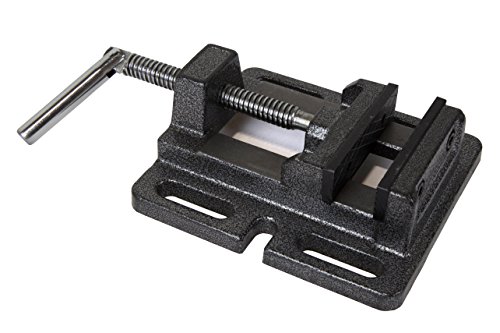
The WEN DPA423 is the compact pick in this roundup, a plain 3-inch drill press vise for small parts and light benchtop presses. Its jaws open to about 3-1/10 inches with a throat depth of 1 inch, which covers small brackets, short bar stock, and thin plates. The body is heavy-duty cast iron, and four mounting slots hold it firmly to most drill press tables.
There is no cross slide here, which is the point for buyers who want a simple, low vise that adds almost no height under the chuck. You clamp, drill, release, and reposition by hand, which is fast for one-off holes and for work that needs no stepped pattern. The hand-powered screw gives direct control over clamping pressure, and the design needs little more than occasional cleaning.
The trade-off is reach and capacity. The 3-inch opening rules out wider stock, and the 1-inch throat gives only shallow jaw engagement on thick parts, so check how much of your workpiece the jaws can grip before ordering. Weight and dimensions were not stated in the sources consulted. This vise suits a small benchtop press, a hobby shop, or anyone who wants a spare vise that lives on the table without crowding the work area.
TEKTON 53994 Drill Press Vise, 4-Inch
The TEKTON 53994 is a straightforward 4-inch drill press vise, model 53994, with no slide mechanism and no tilting cradle. It is the plain fixed vise in this roundup, for buyers who want a solid clamp on the table and nothing to adjust, align, or learn. The 4-inch jaw covers the common middle of drill press work, from small plates and angle stock to short lengths of flat bar.
The listing is a long-standing one, monitored on Amazon since May 2014, which gives it the longest track record of any pick here. Beyond the 4-inch jaw size and the model number, the sources consulted did not state a weight, a throat depth, or a mounting-slot count. Check the listing fields for jaw depth and base layout before ordering, and confirm the bolt pattern against your table.
A fixed vise like this one earns its place by being low, simple, and easy to bolt down and forget. There is no slide play to adjust, no gib screws to snug, and no crank handles to fit, which keeps setup short. The cost is flexibility, since every reposition means unclamping, moving the part by hand, and re-squaring it against the bit. For single holes and small batches, that trade is often the right one.
How to choose
Start with jaw width and opening, since they set the largest workpiece the vise can hold. A 3-inch vise suits small parts, a 4-inch vise covers most benchtop work, and a 6-inch vise is for wide plates and floor-standing presses. Jaw depth matters next, because a shallow throat grips only a thin edge of a thick part.
Decide whether you need a cross slide. If you drill rows of holes, bolt patterns, or tapped layouts, a cross-slide vise moves the part in two directions without unclamping, and 0.1 mm dial increments make those moves repeatable. If you drill one-off holes, a fixed vise is lower, simpler, and cheaper.
Check height and weight against your press. A cross-slide vise stands 5-3/4 to 7-1/4 inches tall, which can leave too little room under the bit on a small benchtop press. A heavier vise resists vibration, but a 59-pound vise is a permanent fixture. Finally, check the base: count the mounting slots or lugs, confirm the bolt pattern against your table slots.
Who should skip
Skip a cross-slide vise if your drill press is a small benchtop model with short spindle travel, since the added height can leave too little room for the bit and the workpiece together. A low fixed vise fits better there. Skip the 6-inch Wilton CS6 if you drill small parts only, since its weight and footprint crowd a small table.
Skip any vise here if you need to mill. None of these turns a drill press into a milling machine. Cross-slide vises are built for drilling accurate rows of holes, and their slides have play that milling cannot tolerate. A milling vise on a proper mill is the right tool.
FAQ
What is a drill press vise?
A drill press vise is a clamp that bolts to a drill press table and holds the workpiece still while the bit cuts. It keeps small parts from spinning, flat stock from creeping, and round stock from rolling. Fixed vises hold the part in one place, while cross-slide vises move it in two directions without unclamping.
Is a cross-slide vise better than a fixed vise?
A cross-slide vise is better when you drill rows of holes, bolt patterns, or tapped layouts, because it moves the workpiece in small, dialed steps without unclamping. A fixed vise is better for one-off holes, since it is lower, simpler, and quicker to set up. Choose by the job, and check the added height against your press first.
How do I stop a drill press vise from spinning?
Bolt the vise to the table through its mounting slots or lugs, using at least two bolts set diagonally and four for the steadiest hold. Keep the jaws clean, tighten the screw firmly, and never hold the workpiece by hand while the bit is turning. If the vise still shifts, check the bolt pattern against the table slots and that the base sits flat.
Can I use a drill press vise for milling?
No. A drill press vise, including a cross-slide vise, is built for drilling accurate rows of holes, and its slides have play that milling cannot tolerate. Milling also loads the drill press spindle sideways, which it is not built to take. Use a milling vise on a proper mill for that work.
Final verdict
The Wilton CS4 is the pick for most benchtop drill presses, with 4-inch jaws, hardened V-grooves, 4.9 inches of travel each way, and a limited lifetime warranty. The Wilton CS6 takes the same design to 6 inches for wide work on a floor-standing press. The WEN CV414 offers the longest travel, with 5.8 by 6 inches of slide and more than 1900 pounds of clamping force. The WEN DPA423 covers small parts on a compact press, and the TEKTON 53994 is the plain 4-inch fixed vise. Measure your table, spindle travel, and largest workpiece first.
Product and ASIN Reference
| Product | ASIN |
|---|---|
| Wilton CS4 Cross Slide Drill Press Vise, 4-Inch | B009E0E9YK |
| Wilton CS6 Cross Slide Drill Press Vise, 6-Inch | B009E0EA3A |
| WEN CV414 Cross Vise, 4.25-Inch | B09Q4H3F8B |
| WEN DPA423 Drill Press Vise, 3-Inch | B09Q4PG9GB |
| TEKTON 53994 Drill Press Vise, 4-Inch | B00FJXYKDQ |
More from Amazon
Programs that pair well with the guide above. Offers and eligibility are set by Amazon and may change.
A free business account with business pricing and bulk-buying tools for work, shop or home office.
Create a business accountFree shipping on eligible items, Prime Video and more. Eligible new members can start with a free trial.
Start a Prime free trialAudiobooks and podcasts to listen to on the go. Eligible new members can start with a free trial.
Try Audible freeAd-free music streaming. Eligible new subscribers can start with a free trial.
Try Music Unlimited freeAs an Amazon Associate we earn from qualifying purchases.

Write Your Review
No reviews yet. Be the first to share your experience!